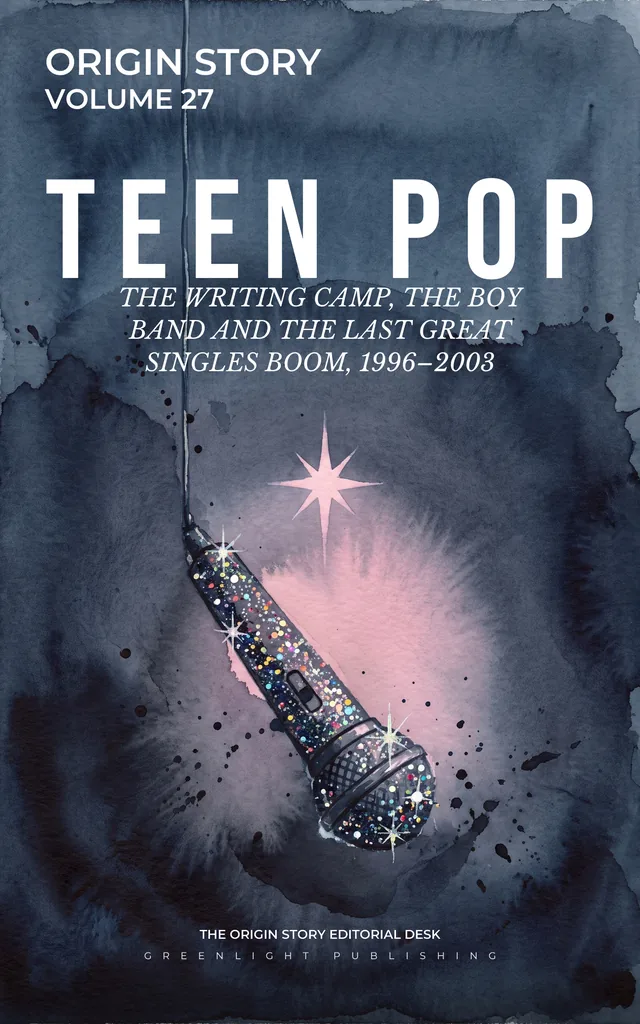
Cover of TEEN POP, volume 27 of Origin Story

Origin Story  ·  Volume 27

TEEN POP

The Writing Camp, the Boy Band and the Last Great Singles Boom, 1996–2003

Where it sits on the century

19151996–20032030
$14.99Paperback
about 120 pages

$13.49 each from three copies, $11.49 from sixteen, and $299.00 for all thirty-one with every ebook and audiobook included. Postage is free on every order over $79.

This is the story of the largest of those cycles: a converted building on an industrial road in Stockholm where songs were built by a division of labour, a company in Orlando that owned two of the three biggest acts in the category at once, and an afternoon television programme that measured the audience daily and fed the measurement straight back into the schedule.

It describes the craft precisely, because the craft is real and is almost never described. What a topliner actually does, step by step, and why the melody is written in nonsense syllables before anybody chooses a word. Why the hook and the title are the same phrase. Why the big notes land on open vowels. What twenty stacked vocal passes sound like when they arrive as one voice, and what a pre-chorus is for.

It takes the money seriously. What a number one actually paid, and to whom. Why the songwriters are rich and several of the performers are not. What a split sheet is, what a producer point costs out of whose share, and what it means to sign a recording contract at fifteen in a jurisdiction where a minor’s signature is voidable — which sounds like protection and produces the opposite.

And it answers the question the sneering account never gets to: how it ended, why the backlash was never really about the music, and why the audience — which is still buying arena tickets twenty-five years later — never left.

Contains no song lyrics. Not one line. That is a deliberate rule, explained on the first page, and what replaces it is a description of what these records actually sound like — the three struck piano notes with silence between them, the drums removed so the chorus lands into a vacuum, the key change into the final section.

Format
Paperback
Trim
5.5 × 8.5 in
Pages
about 120
Chapters
38 in five movements
Period
1996–2003
Audiobook
2h 53m

The playlist

ORIGIN STORY: Teen Pop — public, and sequenced to the order the records appear in Movement Three. The book describes them; the playlist plays them.

Volume 24
NEW JACK SWINGthe producer-as-brand argument, one decade earlier, and the direct ancestor of the arrangement in Movement Four
Volume 28
EMO & NU-METALthe same audience, the same mall, the same years, sold on the promise of being the opposite of this
Volume 31
GLOBAL POPwhere the trainee system takes the model in this book further than anyone in Orlando imagined, and where the machine stops being western

Free to read  ·  the opening

How volume 27 starts.

Origin Story · Volume 27 · TEEN POPIntroduction

The Song Was Written in Sweden

For about seven years, a very large share of the biggest records in the English-speaking world were written in a converted building in an industrial district of Stockholm, by a small number of Swedish men, for American teenagers most of them had never met.

That sentence is the volume. Everything else is the mechanism behind it and the money that came out of it.

The scale is easy to under-feel, because the songs are so familiar that they seem to have always existed. Between 1996 and 2003 a group of writers working out of one Swedish studio (and then out of the studios that budded off it) put songs at number one in the United States, Britain, Germany, Japan and most places in between, repeatedly, across acts that had no other connection to each other. The same few people wrote for a boy band from Orlando, a girl from Louisiana, a rival boy band managed by the same Orlando businessman, a Swedish teenage trio, and a former Mouseketeer. The acts competed with each other for the same chart positions. Their songs came from the same address.

This has happened before in popular music, and this series has already described it twice. The Brill Building in New York put writers in cubicles and had them write for whoever needed a song. Motown ran staff writers in competition and had a committee decide what shipped. What was new by 1996 was not the idea of a song factory. It was the process, and the process is this volume’s machine.

The introduction runs on for another 12 paragraphs, and then the book starts. 38 chapters · about 120 pages · $14.99

Contents

38 chapters, five movements.

Every volume in the series runs the same five, in this order. What each movement is for.

01The Room6 chapters
  1. 1The Man With the Blimps
  2. 2A Studio on an Industrial Road in Stockholm
  3. 3The Pipeline That Was Already Running
  4. 4The Audience Nobody Was Serving
  5. 5This Had Happened Before
  6. 6Britain Had Already Proved It
02The Machine10 chapters
  1. 7Who Signs When You Are Fifteen
  2. 8The Camp
  3. 9What a Topliner Actually Does
  4. 10Melodic Mathematics
  5. 11What the Records Actually Sound Like
  6. 12The Other Camps
  7. 13The Show
  8. 14The Magazine, the Poster and the Second Format
  9. 15The Week That Was the Whole Business
  10. 16An Hour Every Afternoon
03The Records6 chapters
  1. 171995–1998. Europe First, America Later
  2. 181999. The Year It Was Everything
  3. 192000–2001. Full Speed, Then the Turn
  4. 20The Records the Story Leaves Out
  5. 21Three Records That Failed
  6. 222002–2003. Three Records That Ended It
04The Money8 chapters
  1. 23The Split Sheet
  2. 24The Fee, the Share, and Which One You Took
  3. 25The Sixth Member
  4. 26What a Number One Actually Paid
  5. 27The Contract That Took Everything
  6. 28The Territory Problem
  7. 29The Object Business
  8. 30What These Records Earn Now
05The Ending8 chapters
  1. 31A Program Written in a Bedroom
  2. 32The Backlash, and What It Was Actually About
  3. 33What Happened to the People
  4. 34The Audience Never Left
  5. 35The Machine Did Not Need the Acts
  6. 36What It Became
  7. 37What the Story Leaves Out
  8. 38What Was Built Properly

Free to read  ·  reference

TEEN POP: the dates.

The book’s own timeline, in full and free to quote. 22 entries, 1996–2003. Where a date is contested the book says so at the point it appears; these are the ones that are not in serious dispute. All thirty-one timelines on one page.

1989
  • The Disney Channel’s revived children’s variety series begins production in Orlando. It runs until 1994.
1992
  • A studio is established in an industrial district of Stockholm by a former club DJ and a partner. Trans Continental begins assembling a group in Orlando.
1993
  • The five members of the first Orlando group are in place. A young former glam-metal singer from a Stockholm suburb begins working at the Swedish studio under the name he still uses.
1995
  • The second Orlando group is assembled. The first Backstreet Boys single is released, written and produced in Stockholm: a substantial hit in Germany and much of Europe, commercially negligible in the United States.
July 1996
  • Wannabe is released in Britain. It reaches number one in a very large number of countries and demonstrates the scale of the audience.
1996–1997
  • Quit Playing Games (With My Heart) is a hit across Europe, then reaches number two in the United States more than a year later, the territory-sequencing strategy working as designed.
April 1997
  • MMMBop reaches number one in the United States: three brothers from Oklahoma, writing their own material, with none of the apparatus.
1997
  • Show Me Love gives a Swedish teenager an American top-ten hit, eighteen months before the genre is usually said to begin. A pitch-correction plug-in becomes commercially available.
October 1998
  • ...Baby One More Time is released. It goes to number one in the United States and in more than twenty other countries.
September 1998
  • An American music channel launches a daily afternoon countdown programme driven by viewer requests.
April 1999
  • I Want It That Way. A more logically coherent version of the lyric had been written and was declined on the grounds that it sang worse.
June 1999
  • Genie in a Bottle reaches number one, written and produced outside Sweden, demonstrating that the method had become general practice. In the same month, a file-sharing program is released by a nineteen-year-old student.
January 2000
  • Bye Bye Bye.
March–May 2000
  • Oops!... I Did It Again and It’s Gonna Be Me.
2000
  • The Stockholm studio closes, at the height of its success, by the decision of the people running it. Its writers set up separately and carry on.
2001
  • Pop answers the manufactured charge directly. I’m a Slave 4 U moves its performer away from the Swedish writing team. The file-sharing service is enjoined and shut down; successors appear immediately.
2002
  • Complicated, Cry Me a River and Beautiful, three exits from the format by three different routes.
April 2003
  • A computer company opens a download store selling individual tracks at ninety-nine cents, restoring a legal market for the single as a file rather than as an object.
2006–2008
  • The Trans Continental businesses collapse. Pearlman is arrested abroad in 2007 and pleads guilty in 2008 to conspiracy, money laundering and making false statements. He is sentenced to twenty-five years.
2016
  • Pearlman dies in custody.
  • Since
  • Both Orlando groups tour at arena scale. The Swedish writers and their protégés remain among the most commercially successful songwriters in the world, across genres their acts in this book never worked in.

Free to read  ·  where it comes from

The sources.

This series is written from published material and its byline claims method rather than credentials, so the sources are listed. They are given as books and categories of material rather than as page citations; where a claim in the text is contested, the text says so at the point of the claim.

On the Swedish studio and the writing method. The most substantial published account of Cheiron and of the writers who came out of it is The Song Machine: Inside the Hit Factory by John Seabrook, which is the standard work on the topline-and-track division of labour described in the chapter on the camp and on the Stockholm house culture. It is a journalist’s account built on interviews and should be read as such, several of its principal figures gave it extensive access, which is both why it is detailed and why its emphases are theirs.

On melodic construction. The technical vocabulary in the chapter on melodic mathematics (tessitura, pickup, syllabic density, matched stress, answer phrase) is standard musical terminology and is set out in any songwriting or arranging text. The specific application of it to this repertoire has been the subject of a growing body of analytical writing, and readers who want the harmonic detail should go there; this book has deliberately kept to what can be described without notation.

On the Orlando business. The fraud, the guilty plea in 2008, the twenty-five-year sentence and the death in custody in 2016 are matters of public record, reported extensively in the American press and set out in the court documents. The relationship between Trans Continental and the groups is described in the members’ own numerous interviews over three decades, in the reporting of the period, and in the pleadings in the litigation, which was settled on undisclosed terms. The separate allegations of sexual misconduct were reported in a 2007 magazine investigation and in a 2019 documentary in which several individuals spoke on the record; Pearlman denied them and was never charged with a sexual offence. This book states only that, and readers should go to those sources rather than to summaries of them.

On the recording contracts and the arithmetic. The mechanics in Movement Four (recoupment, the dealer-price basis, packaging and free-goods deductions, controlled-composition clauses, producer points paid from record one out of the artist’s share, the structure of a 360 deal) are standard industry practice and are set out in All You Need to Know About the Music Business by Donald Passman, which remains the clearest general explanation available. The specific percentages and sums in this book are illustrative shapes rather than audited figures from any particular contract, and the text says so at each point. The actual agreements are private and this book has not seen them.

On the statutory mechanical rate. The United States rate is set by law and its history is published; through the period of this book it ran between roughly seven and eight cents per song per copy. European and Japanese rates are set differently, as the chapter on the territory problem describes.

On chart positions, release dates and sales. Billboard and the Official Charts Company archives. Sales figures reported by labels are label claims and are treated as such throughout; where a figure is a claim rather than an audited number, the text says so.

On the file-sharing collapse. The launch in June 1999, the litigation, and the 2001 injunction are documented; the subsequent decline in American singles and album sales is in the industry’s own published shipment data. The causal weight to assign to file sharing as against the labels’ own deletion of the commercial single is genuinely contested among economists who have studied it, and this book presents both and adjudicates neither.

On the performers’ own accounts. Several of the people in this book have published memoirs or given extended interviews about the period, including about the pitching of a song that became a defining record, about the pressures of an image strategy, and about subsequent legal arrangements. Where this book reports what somebody said about their own life, it is attributed to them in the sentence. Readers who want those accounts should read them in the subjects’ own words rather than in this summary of them.

Where figures are disputed (the terms of the Orlando settlements, what individual members actually received, the size of any particular advance, the precise split percentages on any particular song) the text says so rather than choosing. Those disagreements are not gaps in the record. They are the record.
What this book does not do

This book quotes no song lyrics. Not one line, not one phrase, not the famous bit. It is a series rule and it is absolute: lyrics are owned, licensing them is negotiated song by song and publisher by publisher, and the copyright office says plainly that there is no safe number of words. A book that quotes a little is making a legal judgement it cannot check. So this one quotes none, and describes instead, what a record sounds like, how it is built, what its words are about, and in what order.

It reproduces no album art and no photographs.

And it cannot play you a record. There is a playlist, sequenced to the order the records appear in these pages. It is called ORIGIN STORY: Teen Pop. Search for it by name.

There is a second thing this book does not do, and it needs saying at the front.

It does not sneer. That should not require stating, and for this genre it does. Most of what has been written about this music since was written from a defensive crouch (either an apology for liking it or an attack on people for having liked it) and both positions treat the records as a symptom of something rather than as work that somebody did. The people who wrote these songs were, by any measure that survives contact with a piano, among the most technically accomplished popular songwriters of the last fifty years, and several of them are still the most successful working today. Taking that seriously is not a defence of the industry that surrounded them, which was frequently indefensible, and this book will be specific about which parts.

Where the record is contested, this book says so. Where it does not know, it says that too. Sources are listed at the back.

Shelved under

MUSIC / Genres & Styles / Pop Vocal  ·  MUSIC / History & Criticism  ·  MUSIC / Business Aspects

Identifiers

Ebook ISBN
979-8-90623-921-1
Audiobook ISBN
979-8-90623-922-8
Paperback ISBN
not yet issued

Buy it

Paperback, $14.99, posted direct. Every ebook and audiobook comes free with the complete set.

Questions

About this volume.

What is Origin Story volume 27 about?

The Writing Camp, the Boy Band and the Last Great Singles Boom, 1996–2003. In 1996 the American record industry was making a great deal of money out of adults, and had left the largest reliable audience in popular music — people aged eight to fifteen, with pocket money, who buy in the first week and buy more than one copy — to be served almost entirely by accident. It was not the first time. This audience has been served deliberately, at enormous scale, roughly once a decade since the 1950s, and each time the arrangement collapsed and was forgotten.

What years does TEEN POP cover?

1996–2003. The volume is numbered 27 because that is where the genre sits in the chronology of the music, not the order the books were written in — the first three written were volumes 17, 19 and 21.

What made TEEN POP possible?

The Scandinavian writing camp. Movement Two of every volume is about the technology that made the genre possible and would not have ten years earlier.

Are there song lyrics in it?

None. Not one line, in this volume or in any of the thirty-one. Lyrics are copyrighted expression, licensing is negotiated song by song and publisher by publisher, and there is no safe quantity — so the rule is zero, and a program checks the manuscript, the EPUB and the narration script against it before the volume ships. What replaces them is a description of what the record actually sounds like, what it cost, and who was paid.

How long is it?

About 29,000 words: 38 chapters across five movements, roughly 120 minutes’ reading, 120 pages in the paperback. The audiobook runs 2h 53m.

What is in the back of the book?

A dated timeline of 22 entries, a source list, and a note on what the volume does not do. All three are reproduced free on this page.

Can I buy TEEN POP in print?

Yes, here. It is a 5.5 × 8.5 in paperback, 60# uncoated cream, black ink, about 120 pages, and it never goes out of print.