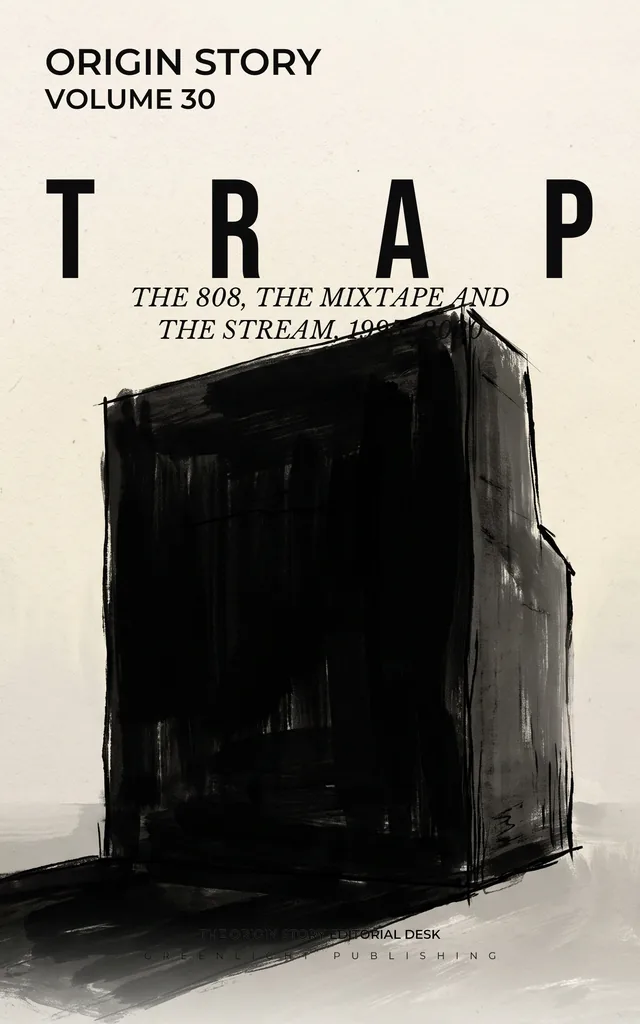
Cover of TRAP, volume 30 of Origin Story

Origin Story  ·  Volume 30

TRAP

The 808, the Mixtape and the Stream, 1995–2020

Where it sits on the century

19151995–20202030
$14.99Paperback
about 118 pages

$13.49 each from three copies, $11.49 from sixteen, and $299.00 for all thirty-one with every ebook and audiobook included. Postage is free on every order over $79.

What a generation of musicians in the American South found in it was that one of its sounds was not a drum at all. Turn the decay up on the kick and the note does not stop: it becomes a sustained, tuneable, physically-felt bass instrument. From which follows one sentence that this entire book is downstream of — if the kick drum is the bassline, you do not need a band — and the emptiest, loudest, most portable popular music ever made.

This is the whole story in about three hours. The Memphis records that had every component of the sound eight years before anybody had the word. The Atlanta strip club that was the most accurate test market in American music, where dancers and thrown cash decided what got released. The tuning of an 808 and the programming of a hi-hat roll, described properly. And the second machine, which is the strangest thing in this series: for a decade the primary format of this genre was a full-length, professionally-made record, with artwork and a release date, that was given away for nothing.

It takes the money seriously, and the ledger is like no other in the series. Why giving the record away was the better deal than the contracts on offer. The feature fee, paid up front in cash and never recouped, which for many artists was the only music income that behaved like a wage. The thirty-dollar beat lease that put the foundation of the world’s dominant popular music in the hands of teenagers on other continents with template contracts. Why a chain around somebody’s neck is a bank when the banking system will not serve you. And what happened when a decade of free records turned out, under streaming, to be the most valuable catalogue in the industry — a fortune decided entirely by who cleared a beat in 2008.

And it ends in a courtroom, because it has to. Prosecutors have repeatedly introduced defendants’ recorded lyrics as evidence in criminal trials, and research going back to the 1990s finds that identical words are judged more harshly when they are labelled as rap. That is the one part of this story that has not been re-evaluated: the music has been rehabilitated and is now the default sound of pop in every language on earth. The people who made it are still being read to juries.

Contains no song lyrics. Not one line. That is a deliberate rule in this series, and in this volume it is also a position: a book about this music that treated its words as freely quotable raw material would be doing, at a distance, the thing its last movement describes.

Format
Paperback
Trim
5.5 × 8.5 in
Pages
about 118
Chapters
44 in five movements
Period
1995–2020
Audiobook
2h 46m

The playlist

ORIGIN STORY: Trap — public, and sequenced to the order the records appear in Movement Three. The book describes them; the playlist plays them.

Volume 28
EMO & NU-METALthe guitar scene whose emotional register, subject matter and occasionally actual samples the upload generation in Movement Two took wholesale, fifteen years later
Volume 29
INDIE & THE BLOG YEARSthe same decade, the same country, the same free-file technology, and an unpaid criticism network running in parallel to this one with almost no overlap in readership
Volume 31
GLOBAL POPwhere the production vocabulary in this book’s craft chapter becomes the first language of popular music in every other language on earth, and the last volume in this series

Free to read  ·  the opening

How volume 30 starts.

Origin Story · Volume 30 · TRAPIntroduction

A Machine That Failed

Every volume of this series has a machine in it, and this one’s was a commercial disaster.

Between 1980 and 1983 a Japanese company manufactured a drum machine. It was intended to let a musician programme rhythm patterns, and it was intended to sound like drums. It did not sound like drums. It sounded like a set of tuned electronic tones (a hollow thud, a thin snap, a hissing rattle) and against the competition, which used short digital recordings of actual drum kits, it sounded cheap and wrong. It sold poorly. Somewhere around twelve thousand were made before production stopped, and one commonly-told reason for the ending is that the company could no longer obtain the particular faulty transistors whose imperfection produced the machine’s noise circuit.

For the next several years you could buy one second-hand for very little money, because nobody who could afford a better one wanted it.

That is the machine, and this book is about what happened when the wrong people got hold of it.

The introduction runs on for another 12 paragraphs, and then the book starts. 44 chapters · about 118 pages · $14.99

Contents

44 chapters, five movements.

Every volume in the series runs the same five, in this order. What each movement is for.

01The Room10 chapters
  1. 1The Box Nobody Wanted
  2. 2Memphis, and the Sound Before the Word
  3. 3The Other Southern Cities
  4. 4Atlanta
  5. 5The Word
  6. 6The Club Was the Test Market
  7. 7The 808, the Roll and the Ad-Lib
  8. 8The Studio Was a Program
  9. 9The Engineer
  10. 10Who Was Actually There
02The Machine12 chapters
  1. 11The Record You Did Not Pay For
  2. 12The Download Site
  3. 13The Camera and the Blog
  4. 14The Beat Was for Sale
  5. 15The Tag
  6. 16The Free Upload
  7. 17The Co-Sign
  8. 18The Playlist Was the Radio
  9. 19The Metric Became the A&R
  10. 20The Stream Counted
  11. 21The Snippet and the Leak
  12. 22Fifteen Seconds and a Sped-Up Edit
03The Records5 chapters
  1. 231995–2005. Before the Name, and the Naming
  2. 242006–2012. The Mixtape Decade
  3. 252013–2016. The Sound Becomes Pop
  4. 262017–2020. The Default
  5. 27The Records the Canon Dropped
04The Money9 chapters
  1. 28How You Get Paid for a Record You Gave Away
  2. 29The Feature Fee
  3. 30What the Show Actually Pays
  4. 31Thirty Dollars for the Foundation
  5. 32The Loop, the Split and the Ten Writers
  6. 33The Clearance Problem
  7. 34The Contract, When There Was One
  8. 35The Chain Was a Bank
  9. 36What a Free Catalogue Turned Out to Be Worth
05The Ending8 chapters
  1. 37The Lyrics in Court
  2. 38What Happened to the People
  3. 39The Backlash, and What It Was Actually About
  4. 40What the Audience Became
  5. 41The Sound Won
  6. 42What It Became
  7. 43What the Story Leaves Out
  8. 44Three Machines

Free to read  ·  reference

TRAP: the dates.

The book’s own timeline, in full and free to quote. 24 entries, 1995–2020. Where a date is contested the book says so at the point it appears; these are the ones that are not in serious dispute. All thirty-one timelines on one page.

1980–1983
  • Roland manufactures the TR-808. It sells poorly and is discontinued, with the commonly-reported reason being the loss of a supply of the faulty transistors that produced its noise circuit. Fewer than fifteen thousand are made.
Mid-1980s
  • Second-hand units are cheap. Musicians in New York, Chicago and Miami find uses for them that the design never anticipated.
1995
  • Three 6 Mafia’s Mystic Stylez. Every sonic component of trap is in place in Memphis, eight years before the word.
1996
  • UGK’s Ridin’ Dirty establishes the conversational Southern writing register that the Atlanta records inherit.
1997
  • A Belgian company releases the pattern-based sequencer that becomes the genre’s dominant production tool, cheap and with lifetime updates.
2003
  • T.I.'s Trap Muzik gives the genre its name, and the argument about whether it is a warning or an advertisement begins immediately.
2005
  • Gucci Mane’s Trap House and Young Jeezy’s Let’s Get It: Thug Motivation 101. The free mixtape Trap or Die outperforms a major-label album as a career event. The dedicated mixtape hosting sites launch. A rap video aggregator launches and becomes the scene’s dominant visual channel.
2006
  • Dedication 2: a free mixtape over borrowed beats demonstrates that an artist can sustain a mass audience entirely outside the industry.
January 2007
  • An Atlanta studio is raided by county sheriff’s deputies with the recording industry’s trade body involved. Two prominent mixtape DJs are arrested on state racketeering charges. The charges are later dropped.
2007
  • Da Drought 3, released free, in the same season.
Late 2000s
  • An audio hosting service launches with no gatekeeper of any kind. Online beat marketplaces establish the lease-and-exclusive model.
2010
  • Flockaveli. The production template that the following decade of global pop is built on is finished.
2012
  • Rich Forever and Based on a T.R.U. Story: the free mixtape is now a standing part of an established artist’s schedule, and an unreconstructed Atlanta trap record enters the American chart at number one.
2013
  • 1017 Thug. The genre’s vocal conventions come apart and it becomes a sound rather than a style.
2014–2016
  • The upload generation emerges with no label, no management and no adults, and takes trap production toward the melodic, the abrasive and the openly emo-indebted.
2015
  • If You’re Reading This It’s Too Late, Rodeo, SremmLife. Atlanta’s production becomes the default of North American pop. A flagship rap playlist launches on a major streaming service.
2016
  • Savage Mode. A single from the previous year returns to number one, eighteen months after release, driven entirely by a user-generated video craze.
2017
  • Culture enters at number one and the triplet flow becomes the default rhythmic vocabulary of popular music. Bodak Yellow reaches number one, the first by a solo female rapper in nearly two decades. Industry consumption reporting has hip-hop as the most-consumed genre in the United States.
2018
  • Astroworld.
2019
  • Old Town Road (a beat bought online for a small sum from a producer in another country) is removed from a country chart on a genre judgement and then spends nineteen weeks at number one, the longest run in the American singles chart’s history.
2020
  • Eternal Atake and Whole Lotta Red. The reduction reaches its endpoint.
November 2021
  • A crowd crush at the Astroworld Festival in Houston results in ten deaths. Civil litigation follows; a grand jury declines to indict in 2023.
2022
  • California enacts a statute restricting the admissibility of creative expression in criminal proceedings. A federal bill on the same question is introduced and is not enacted. A racketeering prosecution in Georgia, citing lyrics in the indictment, is brought against a group of defendants including well-known artists.
2024
  • That prosecution, the longest criminal trial in the state’s history, concludes with the remaining defendants resolving their cases by plea agreement.

Free to read  ·  where it comes from

The sources.

This series is written from published material and its byline claims method rather than credentials, so the sources are listed. They are given as books and categories of material rather than as page citations; where a claim in the text is contested, the text says so at the point of the claim.

Two problems specific to this volume should be stated before the list.

The archive is incomplete and the gaps are not random. A substantial part of this book’s primary material (the free mixtapes of roughly 2005 to 2015) was hosted on sites that have contracted, and a great many of those releases are no longer legitimately available. Where beats were used without licence, the records cannot be commercially reissued at all. So the surviving official record is systematically biased toward the material that happened to be clearable.

And the participants have had good reason to be careful. The chapter on the courtroom describes the practice that makes an artist’s recorded and spoken words potential evidence. What people in this scene have said publicly about their own lives is shaped by that, and any account built on public statements (including this one) inherits the shaping.

On the drum machine. The Roland TR-808’s production history, its commercial failure, and the account of the discontinued transistor are documented in interviews with Roland’s own engineers and in the substantial technical literature on the instrument. Its adoption across hip-hop, electro and Miami bass is covered in this series’ earlier volumes and in the standard histories of those musics.

On Memphis and Houston. The Three 6 Mafia catalogue and the wider Memphis tape scene are documented in the group members’ own extensive interviews and in a growing body of writing on the city’s underground. The Houston scene, including the slowed-mix practice, has its own literature and is set out in Houston Rap and in academic work on the city’s music.

On Atlanta. The most useful general accounts of the city as an industry are the reporting and books produced around the Dungeon Family and LaFace period, and The Rap Year Book and similar surveys for the later decade. The strip club’s role as a test market is documented in a very large body of contemporary reporting, in the clubs’ own public accounts and in the artists’ interviews.

On production technique. The description of 808 tuning, glide, distortion for playback on small speakers, hi-hat roll programming with pitch and velocity contour, and the half-time relationship is standard contemporary production practice, documented in producer interviews, in published tutorials and in the software itself. It is technical description rather than interpretation and can be verified by anybody with the tools.

On the mixtape economy and the 2007 raid. The Atlanta raid of January 2007, the arrests, the seizure and the subsequent dropping of the charges were extensively reported at the time and are matters of public record. The wider mixtape economy is documented in the DJs’ and artists’ own accounts and in contemporaneous trade reporting.

On the beat marketplace. The lease-and-exclusive structure, the pricing and the type-beat convention are visible on the platforms themselves and are documented in producer interviews and in the disputes that have followed. The publishing conventions in hip-hop production are set out in All You Need to Know About the Music Business by Donald Passman alongside the general contract mechanics.

On the contracts and the arithmetic. Recoupment, dealer-price basis, deductions, producer points, imprint stacking and multiple-rights clauses are standard practice and are set out in the same source. Every figure in Movement Four is an illustrative shape or a widely-reported range, not an audited number from any particular contract or invoice, and the text says so. Feature fees in particular circulate as scene knowledge rather than as published data, and are given here as ranges for that reason.

On streaming and consumption. The finding that hip-hop became the most-consumed genre in the United States is from the industry’s own annual consumption reporting. Chart methodology changes are published by the chart compilers.

On lyrics as evidence. The practice is documented across decades of American case law and in a substantial legal and social-science literature; the experimental finding that identical lyrics are judged more harshly when labelled as rap dates to research first published in the 1990s and has been replicated. The California statute of 2022 and the federal bill introduced in the same period are public legislative records. The Georgia racketeering prosecution commenced in 2022, its length, and its resolution by plea agreements in 2024 are matters of public court record. This book states procedural facts and takes no position on the merits of any charge or the guilt of any person.

On convictions, allegations and deaths. Where a person in this book has been convicted of an offence, the conviction is stated as fact. Where allegations have been made, they are stated as allegations with the response where one was given. Where a person has died, the fact is recorded and no circumstances are described. The Astroworld Festival crowd crush of November 2021, the resulting deaths, the civil litigation and the grand jury’s decision not to indict in 2023 are matters of public record and are stated as such.

On chart positions, release dates and personnel. The Billboard archives and the releases themselves. Sales and streaming figures reported by labels or platforms are claims and are treated as such.

Where figures are disputed (what any particular deal contained, what any particular feature cost, how any particular dispute was resolved) the text says so rather than choosing. Those disagreements are not gaps in the record. They are the record.
What this book does not do

Before the book starts: what it will not do, and what it does with the room that leaves.

This book quotes no song lyrics. Not one line, not one phrase, not the famous bit. That is a deliberate rule and it is absolute, and song lyrics are owned, licensing them is negotiated song by song and publisher by publisher, and there is no safe word count: the copyright office says so in as many words. A book that quotes a little is a book making a legal judgement it cannot check. So this one quotes none, and instead does the harder and more interesting thing, which is to tell you what a record actually sounds like and what its words are about.

For this volume that rule costs more than usual and also matters more than usual, and the reason is the most serious sentence in this book. In the period it covers, prosecutors in the United States repeatedly introduced defendants’ recorded lyrics as evidence against them in criminal trials. A book about this music that treated its words as freely quotable raw material would be participating, at a distance, in exactly the practice its final movement describes. So the words stay with the people who wrote them, and this book describes what they are about instead.

It reproduces no album art and no photographs. There is nothing to look at here but words and one flat poster on the cover.

It cannot play you a record, which is the real limitation. What it can do is point. There is a playlist for this book, on the same app you may well be reading or listening on, sequenced to the order the records appear in these pages. It is called ORIGIN STORY: Trap. Search for it by name. Everything described in Movement Three is on it, in order, and the book is substantially better with it running.

One more thing, specific to this volume. This music has been treated, for twenty years, as a social problem with a soundtrack attached. This book does not do that. It takes the records seriously (the tuning of a kick drum, the mathematics of a hi-hat roll, the engineering of a vocal, the design of a distribution system that gave the music away for a decade) because they were made seriously, by people with genuine technical command, and because trap became the default sound of popular music worldwide, which does not happen by accident. Where the subject matter is violent, and it frequently is, the book says what it is about and does not moralise about it or celebrate it. Where a person in this book has been convicted of something, the conviction is stated. Where they have been accused, the accusation is stated as an accusation. And where somebody has died, this book records the fact and nothing else.

The rule costs this volume something specific: this is a music where the voice is often used as a texture and the phrasing carries more than the sentence, so describing it without quoting it is a genuine craft problem. It is also the right problem to have, because the phrasing is the part that can be explained. The whole story, start to finish, in about three hours: where the sound came from, what machinery made it enormous, which records mattered and why, who got paid, who did not, and how a music that gave itself away for free for ten years became the most valuable catalogue in the industry. Where the record is contested, this book says so. Where it does not know, it says that too. Sources are listed at the back.

Shelved under

MUSIC / Genres & Styles / Rap & Hip Hop  ·  MUSIC / History & Criticism  ·  MUSIC / Business Aspects

Identifiers

Ebook ISBN
979-8-90623-927-3
Audiobook ISBN
979-8-90623-928-0
Paperback ISBN
not yet issued

Buy it

Paperback, $14.99, posted direct. Every ebook and audiobook comes free with the complete set.

Questions

About this volume.

What is Origin Story volume 30 about?

The 808, the Mixtape and the Stream, 1995–2020. Every volume of this series has a machine in it. This one’s was a commercial disaster: a drum machine made between 1980 and 1983 that did not sound like drums, sold badly, was discontinued when the manufacturer ran out of the faulty transistors that made its noise circuit — and could then be bought second-hand for almost nothing.

What years does TRAP cover?

1995–2020. The volume is numbered 30 because that is where the genre sits in the chronology of the music, not the order the books were written in — the first three written were volumes 17, 19 and 21.

What made TRAP possible?

The 808, the mixtape, the stream. Movement Two of every volume is about the technology that made the genre possible and would not have ten years earlier.

Are there song lyrics in it?

None. Not one line, in this volume or in any of the thirty-one. Lyrics are copyrighted expression, licensing is negotiated song by song and publisher by publisher, and there is no safe quantity — so the rule is zero, and a program checks the manuscript, the EPUB and the narration script against it before the volume ships. What replaces them is a description of what the record actually sounds like, what it cost, and who was paid.

How long is it?

About 28,000 words: 44 chapters across five movements, roughly 115 minutes’ reading, 118 pages in the paperback. The audiobook runs 2h 46m.

What is in the back of the book?

A dated timeline of 24 entries, a source list, and a note on what the volume does not do. All three are reproduced free on this page.

Can I buy TRAP in print?

Yes, here. It is a 5.5 × 8.5 in paperback, 60# uncoated cream, black ink, about 118 pages, and it never goes out of print.