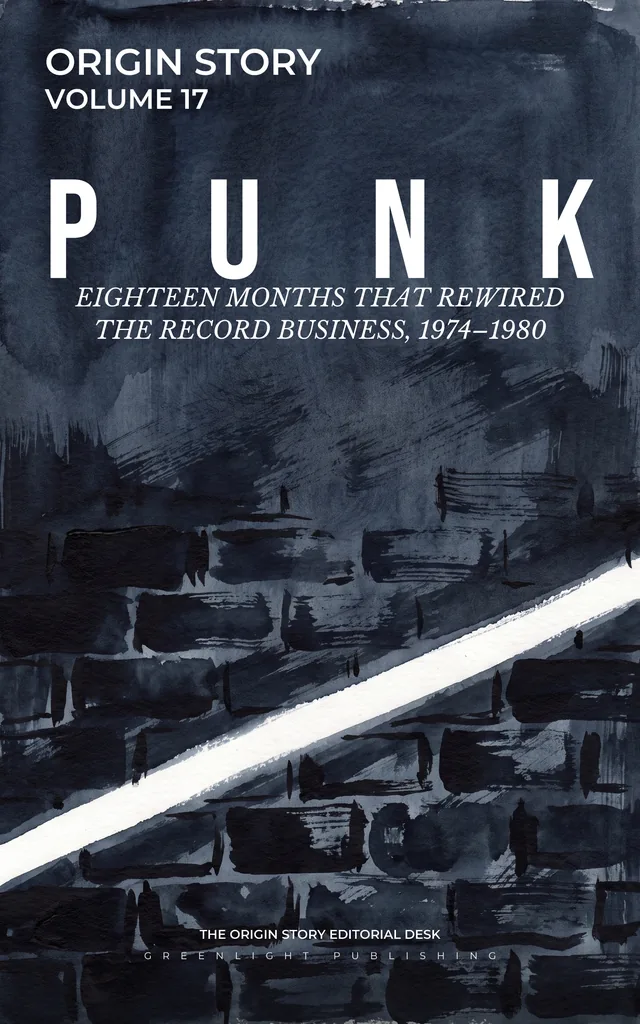
Cover of PUNK, volume 17 of Origin Story

Origin Story  ·  Volume 17  ·  the first written

PUNK

Eighteen Months That Rewired the Record Business, 1974–1980

Where it sits on the century

19151974–19802030
$14.99Paperback
about 120 pages

$13.49 each from three copies, $11.49 from sixteen, and $299.00 for all thirty-one with every ebook and audiobook included. Postage is free on every order over $79.

This is the complete story of punk in about three hours: the failing Bowery bar whose only rule was that you had to play your own songs; the clothes shop that assembled a band; the four hundred pounds it actually cost to press a thousand singles, and the three hundred copies you had to sell to break even; the office photocopier that turned a bank clerk in Deptford into a national publisher; and the four competing weekly newspapers that could turn two hundred people in London into a national argument in six weeks.

It takes the money seriously, because the people in it did. What an advance really is, and why a band with a number-one album can receive nothing at all. Why the songwriter in the band is solvent and the drummer is not. What twenty per cent of gross does to a tour that broke even. And the invention that outlived every record in the book — not a label and not a sound, but a distribution network owned by the people using it, which is the reason there is an independent sector at all.

And it answers the question most books about punk decline to ask: how it ended. Not with a tragedy — with a rack in a record shop, which is the same thing.

Contains no song lyrics. Not one line. That is a deliberate rule, explained on the first page, and what replaces it is a description of what these records actually sound like — the downstrokes with no swing in them, the drum figure that does not belong in the genre, the twenty-eight-second song that stops before you are ready.

Format
Paperback
Trim
5.5 × 8.5 in
Pages
about 120
Chapters
25 in five movements
Period
1974–1980
Audiobook
2h 51m

The playlist

ORIGIN STORY: Punk — public, and sequenced to the order the records appear in Movement Three. The book describes them; the playlist plays them.

Volume 18
POST-PUNK & NEW WAVEthe same people, the same labels, the permission kept and the sound thrown away
Volume 21
HOUSE & TECHNOManchester 1977’s method, arriving in Chicago in 1984 from the opposite direction
Volume 16
DISCOthe parent of both, and the one this book has been unfair to

Free to read  ·  the opening

How volume 17 starts.

Origin Story · Volume 17 · PUNKIntroduction

The Permission Problem

In 1974, if you were nineteen years old and you wanted to make a record, here is what stood in your way.

You needed a recording studio, which cost money by the hour and did not rent itself to people without a booking history. You needed an engineer, because the desk was not something you could learn in an afternoon. You needed a pressing plant, and the plants ran on minimum orders in the thousands and preferred to deal with companies that had ordered before. You needed sleeves printed, which was a separate trade with its own minimums. You needed to get the finished object into shops, and the shops bought from distributors, and the distributors carried the labels they already carried and had no mechanism for a box of records arriving in the post from a stranger. You needed the record played on radio, and radio took its records from a small number of pluggers who worked for a small number of companies.

Every one of those was a door, and every door had somebody standing at it whose job was to decide. The polite word for the arrangement was the industry. The accurate description is that a few hundred people in London, New York and Los Angeles held a veto over what the rest of the world was allowed to hear.

They were not, on the whole, villains. Most of them liked music. Several of them were very good at their jobs. But the structure had a property that nobody had designed and nobody could switch off: it selected for things that resembled the things it had already sold. A young man with a guitar and a folk sensibility could get a hearing in 1974 because a young man with a guitar and a folk sensibility had made money in 1971. A band who wanted to spend nine months and forty thousand pounds making an album with an orchestra could get a hearing, because that had worked too. What could not get a hearing was a band that had existed for four months, could play three chords, had no interest in getting better at their instruments, and wanted to make a record that lasted ninety seconds and cost almost nothing, because there was no filing cabinet that shape.

The introduction runs on for another 10 paragraphs, and then the book starts. 25 chapters · about 120 pages · $14.99

Contents

25 chapters, five movements.

Every volume in the series runs the same five, in this order. What each movement is for.

01The Room4 chapters
  1. 1A Bar on the Bowery
  2. 2A Shop on the King’s Road
  3. 3The Provinces, and Why the Method Travelled
  4. 4Who Was Actually There
02The Machine5 chapters
  1. 5The Cheap Seven-Inch
  2. 6The Photocopier
  3. 7Four Newspapers, Every Thursday
  4. 8What the Instruments Cost
  5. 9Why the Records Sound Like That
03The Records6 chapters
  1. 101976. The Door Comes Off
  2. 111977. The Year Everything Arrived
  3. 121978–1980. What Was Built With It
  4. 13The Records the Canon Dropped
  5. 14The Ones the Rack Swallowed
  6. 15Three Records That Failed
04The Money6 chapters
  1. 16The Advance, and What It Actually Is
  2. 17Who Owned the Publishing
  3. 18The Twenty Per Cent Nobody Mentions
  4. 19Fifty-Fifty, and the Thing That Actually Changed
  5. 20What a Punk Record Actually Earned
  6. 21What These Records Earn Now
05The Ending4 chapters
  1. 22What Exhausted It
  2. 23What It Became
  3. 24What the Story Leaves Out
  4. 25The Doors Were Never Locked

Free to read  ·  reference

PUNK: the dates.

The book’s own timeline, in full and free to quote. 49 entries, 1974–1980. Where a date is contested the book says so at the point it appears; these are the ones that are not in serious dispute. All thirty-one timelines on one page.

1973
  • December. Hilly Kristal puts up the CBGB awning at 315 Bowery, New York, intending to book country and bluegrass.
1974
  • Spring. Television persuade Kristal to book them. His condition, which becomes the rule of the house: you play your own songs.
  • Summer. Patti Smith, Lenny Kaye and Richard Sohl record two songs, paid for by Robert Mapplethorpe, released on their own label. The first object in this book.
  • August, the Ramones play their first show at CBGB.
  • Autumn. Malcolm McLaren, in New York, briefly manages the New York Dolls and observes Richard Hell.
1975
  • Rocket from the Tombs split in Cleveland; the pieces become Pere Ubu and the Dead Boys. Pere Ubu self-release a single on their own label, Hearthan.
  • June. Talking Heads play their first CBGB show.
  • August. John Lydon auditions in a shop at 430 King’s Road.
  • 6 November, the Sex Pistols play their first show, at Saint Martins School of Art. Somebody pulls the power.
  • December, Horses is released. The first album by a CBGB band.
1976
  • January, the first issue of Punk magazine names the thing.
  • February. Geoff Travis opens Rough Trade at 202 Kensington Park Road, London.
  • April, the first Ramones album. Fourteen songs, twenty-nine minutes.
  • 4 June and 20 July, the Sex Pistols play the Lesser Free Trade Hall, Manchester, both shows organised by Pete Shelley and Howard Devoto.
  • July. Mark Perry photocopies the first issue of Sniffin’ Glue. Stiff Records is founded on a loan from the singer of a pub-rock band.
  • September, the Saints self-release a single in Brisbane, weeks before Britain’s first. Sounds in London makes it single of the week.
  • 20–21 September, the 100 Club punk festival. Siouxsie and the Banshees perform for the first time. The club stops booking punk shows.
  • 22 October, New Rose, on Stiff. The first British punk single.
  • 26 November, Anarchy in the U.K., on EMI.
  • 1 December, the Sex Pistols swear at Bill Grundy on early-evening television. Bookings collapse across the country.
  • Late December, the Roxy opens in Covent Garden. It has about a hundred days.
  • 28 December. Buzzcocks record four songs in Manchester for about five hundred pounds.
1977
  • January, Spiral Scratch is released on New Hormones, with the label’s address on the sleeve. EMI drop the Sex Pistols. Sideburns prints Tony Moon’s three-chord diagram.
  • February, Damned Damned Damned, the first British punk album. Marquee Moon, which is not one. The Saints’ first album.
  • March, the Sex Pistols sign to A&M outside Buckingham Palace and are dropped within about a week.
  • April, the Roxy’s original management loses the lease. The Clash is released; CBS in America decline to release it.
  • May, the Sex Pistols sign to Virgin. God Save the Queen reaches number two in Jubilee week.
  • 7 June, the boat on the Thames. Arrests at the pier.
  • July. Elvis Costello’s first album, on Stiff.
  • September, Oh Bondage Up Yours!
  • 28 October, Never Mind the Bollocks enters at number one.
  • November, Rocket to Russia. The Nottingham prosecution over the album title is dismissed.
  • December, Pink Flag: twenty-one songs in thirty-five minutes.
1978
  • 14 January, the Sex Pistols’ last show, in San Francisco. Lydon walks.
  • February. Howard Devoto has already left Buzzcocks; Magazine’s first single appears.
  • 30 April, the Rock Against Racism carnival in Victoria Park.
  • Summer. Rough Trade begins releasing records. Factory Records is founded in Manchester.
  • August. Siouxsie and the Banshees, unsigned for two years, reach the British top ten with their first single.
  • September. Wire’s Chairs Missing: keyboards, effects, longer songs, nine months after Pink Flag.
  • October. Nancy Spungen is found dead in New York.
  • November, Germfree Adolescents.
1979
  • February. Sid Vicious dies, aged twenty-one. Inflammable Material reaches number fourteen: the first independent album to chart that high in Britain.
  • September, Cut.
  • Coventry, 2 Tone begins releasing records.
1980
  • January, the trade press begins publishing a separate independent chart.
  • April, Los Angeles.
  • Washington DC. Dischord Records is founded.
1981
  • December, Damaged, on SST, after a major distributor withdraws.
1986
  • The Sex Pistols litigation concludes, substantially in the band’s favour, eight years after it began.

Free to read  ·  where it comes from

The sources.

This series is written from published material and its byline claims method rather than credentials, so the sources are listed. They are given as books and categories of material rather than as page citations; where a claim in the text is contested, the text says so at the point of the claim.

Oral histories and contemporaneous accounts. Please Kill Me: The Uncensored Oral History of Punk, Legs McNeil and Gillian McCain, the standard oral account of the New York scene, and the source most often quoted for CBGB and the Punk magazine circle. Read with the usual caution owed to oral history: it is a compilation of recollections, many of them decades later, by people who were frequently intoxicated at the time and who disagree with one another.

The London scene. England’s Dreaming: Sex Pistols and Punk Rock, Jon Savage, the fullest documentary history of the British scene, and the source that takes the business and the media coverage most seriously. The Boy Looked at Johnny, Julie Burchill and Tony Parsons, is a contemporaneous 1978 polemic rather than a history and is useful precisely as evidence of the arguments being had at the time.

The independent sector. Rip It Up and Start Again: Postpunk 1978–1984, Simon Reynolds, the best account of what happened next and of the labels that carried it. Our Band Could Be Your Life, Michael Azerrad, thirteen chapters on American independent bands including Black Flag, Minor Threat and the touring circuit described in Movement Five. Document and Eyewitness: An Intimate History of Rough Trade, Neil Taylor.

Memoirs by participants, all to be read as interested accounts: John Lydon, Rotten: No Irish, No Blacks, No Dogs and Anger Is an Energy; Viv Albertine, Clothes, Clothes, Clothes. Music, Music, Music. Boys, Boys, Boys; Patti Smith, Just Kids, for the Mapplethorpe-financed single described in Movement One; Steve Jones, Lonely Boy.

The fanzines themselves. Sniffin’ Glue (Mark Perry, twelve issues, 1976–77) and Sideburns (Tony Moon), the latter the actual source of the three-chord diagram commonly misattributed to the former; substantial runs of both have been reproduced in facsimile.

The music press of the period (NME, Sounds, Melody Maker and Record Mirror, weekly, 1976–1980) for release dates, chart positions, contemporaneous reviews and the correspondence pages, which are the best available record of what the audience actually argued about.

For chart positions and release dates, the Official Charts Company (UK) and Billboard (US) archives.

On the business. The mechanics in Movement Four (recoupment, packaging and breakage deductions, the separation of publishing from recording income, mechanical and performance royalties) are standard industry practice of the period and are set out in any reputable music-business text; All You Need to Know About the Music Business, Donald Passman, remains the clearest general explanation, though it describes a later era and the specific 1977 percentages in this book are illustrative. The Sex Pistols litigation was reported extensively in the British press through the early 1980s and concluded in 1986.

Where figures are disputed (the size of the Sex Pistols’ advances, the attendance at the first Lesser Free Trade Hall show, the exact cost of Spiral Scratch, whether God Save the Queen was kept off the top of the chart) the text says so rather than choosing. Those disagreements are not gaps in the record. They are the record.

What this book does not do

Know what you are buying. This is not the book about punk you have probably already read.

This book quotes no song lyrics. Not one line, not one phrase, not the famous bit. That is a deliberate rule and it is absolute, and song lyrics are owned, licensing them is negotiated song by song and publisher by publisher, and there is no safe word count: the copyright office says so in as many words. A book that quotes a little is a book making a legal judgement it cannot check. So this one quotes none, and instead does the harder and more interesting thing, which is to tell you what a record actually sounds like and what its words are about.

It reproduces no album art and no photographs. There is nothing to look at here but words and one flat poster on the cover.

And it cannot play you a record, which is the real limitation, and there is no point pretending otherwise. What it can do is point. There is a playlist for this book, on the same app you may well be reading or listening on, sequenced to the order the records appear in these pages. It is called ORIGIN STORY: Punk. Search for it by name. Everything described in Movement Three is on it, in order, and the book is substantially better with it running.

Not much is lost. Punk’s lyrics were mostly slogans and everyone already knows them, which is precisely why so little has been written about the invoices. This book is the other half: the whole story, start to finish, in about three hours. Where it came from, what made it possible, which records mattered and why, who got paid, who did not, and how it ended. That last question is the one most books about punk decline to answer, and it is the most interesting one in the subject.

Where the record is contested, this book says so. Where it does not know, it says that too. Sources are listed at the back.

Shelved under

MUSIC / History & Criticism  ·  MUSIC / Genres & Styles / Punk  ·  MUSIC / Business Aspects

Identifiers

Ebook ISBN
979-8-90623-807-8
Audiobook ISBN
979-8-90623-808-5
Paperback ISBN
not yet issued

Buy it

Paperback, $14.99, posted direct. Every ebook and audiobook comes free with the complete set.

Questions

About this volume.

What is Origin Story volume 17 about?

Eighteen Months That Rewired the Record Business, 1974–1980. In 1974, making a record meant getting past a studio, an engineer, a pressing plant, a printer, a distributor and a radio plugger — and every one of those was a door with somebody standing at it. Two years later a handful of people in Manchester, London, New York and Brisbane worked out, independently and almost simultaneously, that the doors were not locked. They were only closed.

What years does PUNK cover?

1974–1980. The volume is numbered 17 because that is where the genre sits in the chronology of the music, not the order the books were written in — the first three written were volumes 17, 19 and 21.

What made PUNK possible?

The cheap seven-inch and the photocopier. Movement Two of every volume is about the technology that made the genre possible and would not have ten years earlier.

Are there song lyrics in it?

None. Not one line, in this volume or in any of the thirty-one. Lyrics are copyrighted expression, licensing is negotiated song by song and publisher by publisher, and there is no safe quantity — so the rule is zero, and a program checks the manuscript, the EPUB and the narration script against it before the volume ships. What replaces them is a description of what the record actually sounds like, what it cost, and who was paid.

How long is it?

About 28,500 words: 25 chapters across five movements, roughly 120 minutes’ reading, 120 pages in the paperback. The audiobook runs 2h 51m.

What is in the back of the book?

A dated timeline of 49 entries, a source list, and a note on what the volume does not do. All three are reproduced free on this page.

Can I buy PUNK in print?

Yes, here. It is a 5.5 × 8.5 in paperback, 60# uncoated cream, black ink, about 120 pages, and it never goes out of print.