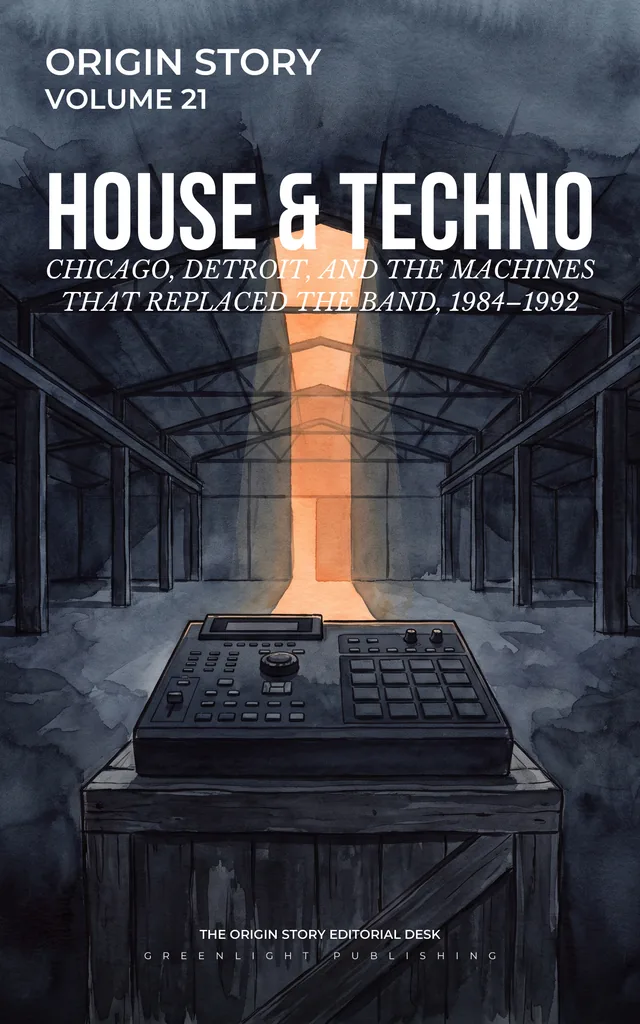
Cover of HOUSE & TECHNO, volume 21 of Origin Story

Origin Story  ·  Volume 21  ·  the first written

HOUSE & TECHNO

Chicago, Detroit, and the Machines That Replaced the Band, 1984–1992

Where it sits on the century

19151984–19922030
$14.99Paperback
about 120 pages

$13.49 each from three copies, $11.49 from sixteen, and $299.00 for all thirty-one with every ebook and audiobook included. Postage is free on every order over $79.

They went back to the clubs, and this book is about what they made there.

This is the complete story of house and techno in about three hours, and it begins by putting the most common framing exactly backwards: house is not disco’s opposite. House is disco’s survival — made in a Chicago members’ club with a largely Black and gay membership, by a DJ who had come from New York, for people who were still dancing because there was nowhere else for that audience to be. What changed was who could make a record. Nobody in Chicago in 1984 could afford a band, and what they found instead, cheap and second-hand, were three machines that had recently failed: a drum machine discontinued because it did not sound like drums, a second discontinued inside a year, and a small silver bass box so bad at its intended job that it was withdrawn — then made famous by people who could not work out how to program it and started turning its knobs while a sequence ran. One person, an afternoon, a low four-figure sum: a record. It is the lowest barrier to entry in this entire series, and this book explains precisely how the machines, the kick drum on every beat and the twelve-inch format fit together into a music built for a room rather than a listener.

It takes the money seriously, because nobody paid these people to. The most important label in Chicago was owned by the man who owned the pressing plant, and the royalty complaints from that roster have stayed uniform for four decades. Two hundred and fifty miles away, three teenagers in Detroit did the opposite and owned their labels from the first record — a decision whose consequences compound to this day. And then the discovery that reorganised the economics of dance music permanently: the record was the advertisement, the DJ appearance was the product, and a weekend of European bookings could exceed a year of record royalties.

Because that is how this one ends — and it is the only ending of its kind in the series. The music did not exhaust itself and no court stopped it. It emigrated. By 1990 the cities that invented it had largely stopped paying for it, its makers’ entire market was three thousand miles away in Europe, and men with internationally famous records were flying home from airports full of fans to ordinary jobs. The kick drum they built is now the rhythmic default of global popular music. The records blown up in that outfield are, most of them, still in print.

Contains no song lyrics. That is a series rule, explained on the first page. In this volume it costs almost nothing — much of this music has no words at all — and where the words matter, and in the two most quoted spoken passages in all of dance music they matter enormously, you will be told what they argue, not how they are worded.

Format
Paperback
Trim
5.5 × 8.5 in
Pages
about 120
Chapters
32 in five movements
Period
1984–1992
Audiobook
2h 54m

The playlist

ORIGIN STORY: House & Techno — public, and sequenced to the order the records appear in Movement Three. The book describes them; the playlist plays them.

Volume 16
DISCOthe parent, and the music this book argues never actually died
Volume 22
RAVE & JUNGLEwhere this goes next, three thousand miles away, with a sampler and a pirate transmitter
Volume 17
PUNKa different city, a different decade, the opposite parent, and exactly the same discovery

Free to read  ·  the opening

How volume 21 starts.

Origin Story · Volume 21 · HOUSE & TECHNOIntroduction

They Blew Up the Records in a Baseball Stadium

On 12 July 1979, between the two games of a baseball doubleheader at Comiskey Park on the South Side of Chicago, a crate of disco records was detonated on the outfield grass in front of a crowd of tens of thousands of people.

The promotion had been organised by a local radio DJ who had built an audience out of hostility to disco. Admission was cut to a nominal sum for anybody who brought a record to be destroyed. The crowd was far larger than anticipated (accounts put attendance well beyond the stadium’s normal draw, with thousands more outside) and after the explosion a substantial part of it came over the barriers and onto the field. The turf was torn up. Bases were taken. The second game could not be played and was forfeited.

It is remembered as a piece of Americana: a stunt that got out of hand, a funny story about a radio DJ, a photograph of a crater in an outfield.

It was also the most public destruction of a musical genre in modern history. Be exact about what was being destroyed.

The introduction runs on for another 14 paragraphs, and then the book starts. 32 chapters · about 120 pages · $14.99

Contents

32 chapters, five movements.

Every volume in the series runs the same five, in this order. What each movement is for.

01The Room8 chapters
  1. 1Where the Audience Went
  2. 2The Room Before This One
  3. 3The Warehouse
  4. 4The Music Box
  5. 5Five DJs, Every Saturday Night
  6. 6Three Kids in Belleville
  7. 7The Other Cities
  8. 8The Rooms Were Also Funerals
02The Machine6 chapters
  1. 9Three Commercial Failures
  2. 10Four to the Floor
  3. 11The Turntable Was an Instrument
  4. 12The Sound System
  5. 13A Band You Do Not Have to Pay
  6. 14How These Records Were Actually Made
03The Records6 chapters
  1. 15Detroit, 1981–1983
  2. 16Chicago, 1984–1986
  3. 17Detroit, 1985–1987
  4. 18The Songs, 1987–1989
  5. 191987–1992. The Sound Leaves
  6. 20The Voice
04The Money6 chapters
  1. 21The Man Who Owned the Pressing Plant
  2. 22The Other Answer, Two Hundred and Fifty Miles Away
  3. 23The Fee That Replaced the Royalty
  4. 24Somebody Else’s Record
  5. 25What a House Record Actually Earned
  6. 26What These Records Earn Now
05The Ending6 chapters
  1. 27It Left the Country
  2. 28Britain, 1988–1989
  3. 29The Continent
  4. 30What the Story Leaves Out
  5. 31What It Became
  6. 32The Kick Drum Is Still There

Free to read  ·  reference

HOUSE & TECHNO: the dates.

The book’s own timeline, in full and free to quote. 14 entries, 1984–1992. Where a date is contested the book says so at the point it appears; these are the ones that are not in serious dispute. All thirty-one timelines on one page.

1970
  • a private party begins in a loft on Broadway in New York: members only, no alcohol, an obsessive sound system. Everything in this book descends from that room.
1977
  • a members’ club opens on King Street in New York with Larry Levan resident. In Chicago, a members’ club opens on the near west side with Frankie Knuckles resident, newly arrived from New York.
12 July 1979
  • a crate of disco records is detonated between games of a baseball doubleheader at Comiskey Park, Chicago. The second game is forfeited. Within about a year American radio has abandoned the format.
1980
  • a Roland drum machine is released. It does not sound like drums and does not sell.
1981
  • a Roland bass accompaniment unit is released. It does not sound like a bass guitar. In Chicago, WBMX puts five mixing DJs on its Saturday nights. In Detroit, Juan Atkins makes his first record as half of Cybotron.
1982
  • Cybotron’s Cosmic Cars. In Manchester, Factory Records and New Order open the Haçienda; it will stand mostly empty for years.
1983
  • the MIDI standard is agreed, and one person can run a studio. A second Roland drum machine is released and is discontinued within about a year. Ron Hardy begins at the Music Box. Cybotron release Clear.
1984
  • the bass box is discontinued and dumped on the second-hand market. On and On is pressed in Chicago. Chicago’s principal house label is founded by a man who owns a pressing plant.
1985
  • Juan Atkins founds his own label in Detroit and releases No UFO’s on it. Affordable samplers reach small studios.
1986
  • Your Love, No Way Back, Move Your Body and Can You Feel It. Derrick May founds his own label. In September, Love Can’t Turn Around reaches the British top ten.
1987
  • Acid Tracks, made on the discontinued bass box by people who could not program it conventionally, and played repeatedly at the Music Box. Strings of Life and Nude Photo in Detroit. Kevin Saunderson founds his label and makes the bass sound that will underpin an entire British genre. The Paradise Garage closes in September. In Britain, Jack Your Body is number one in January; four London DJs holiday in Ibiza in August.
1988
  • Big Fun and Good Life reach the British charts. A British compilation of Detroit records is released; its working title calls the music house, and at the artists’ insistence the sleeve says techno instead. Voodoo Ray is made in Manchester. Acid house fills the Haçienda and the new London clubs; Britain’s warehouse scene begins, and by the autumn the tabloids have turned.
1989
  • Pacific State and French Kiss. Underground Resistance is founded in Detroit. The orbital raves circle London on the new motorway, and a police unit is formed against them. In July, about a hundred and fifty people dance through West Berlin behind a truck, registered as a political demonstration; in November, the Wall opens.
1990–92
  • Chicago’s scene collapses commercially. American producers earn their living almost entirely from European bookings. In Britain, 1990 legislation prices the field rave out of existence. Underground Resistance’s records reach Berlin. Detroit establishes its own distribution. Larry Levan dies in 1992, aged thirty-eight; Ron Hardy dies the same year, aged thirty-three.

Free to read  ·  where it comes from

The sources.

This series is written from published material and its byline claims method rather than credentials, so the sources are listed. They are given as books and categories of material rather than as page citations; where a claim in the text is contested, the text says so at the point of the claim.

The standard histories. Last Night a DJ Saved My Life, Bill Brewster and Frank Broughton, the fullest history of the DJ as a figure, and the indispensable source for Movement One’s New York chapters. Energy Flash, Simon Reynolds, the standard account of what happened after this book ends, and the best single source on how Chicago and Detroit records were received in Britain. Techno Rebels, Dan Sicko, the Detroit book, and the source most careful about the distinction between the two cities.

On Chicago specifically. The Underground Is Massive, Michaelangelo Matos, for the American story across the whole period. Love Saves the Day, Tim Lawrence, for the New York club culture this music inherits, and Life and Death on the New York Dance Floor for what followed. Jesse Saunders’s own account of the earliest records is an interested source and should be read as one; competing claims about who pressed first exist and this book reports the standard account rather than adjudicating. The radio chapter rests on the participants’ retrospective interviews and Chicago’s local press; the audience figures are the station’s and the DJs’ own claims, and the text labels them as claims.

On the equipment. Manufacturer documentation and the extensive technical literature on the three machines in Movement Two, which is unusually good because the instruments have been reverse-engineered and re-created many times. Analog Days, Trevor Pinch and Frank Trocco, for how electronic instruments reach musicians in the first place.

On the epidemic. And the Band Played On, Randy Shilts, for the chronology and the institutional failure. This book states only the collective and documented facts and makes no claim about any individual’s health, for the reason given in that chapter.

On Britain. Altered State, Matthew Collin, for acid house, the drug and the panic; The Haçienda: How Not to Run a Club, Peter Hook, for what the Manchester club cost and who paid for it. Energy Flash, above, throughout.

On the business. The disputes over the Chicago catalogue have been reported extensively in the music press across four decades and have generated litigation continuing into the present. This book reports the artists’ consistent public accounts as their accounts, which is what they are. Creative License, Kembrew McLeod and Peter DiCola, for what sample clearance costs and why so much early house is now technically unclearable.

Contemporaneous press. The British weekly music papers from 1987, the British dance press from 1988, and Billboard's dance coverage throughout. Chicago’s local coverage of its own scene in the mid-eighties is thin, which is itself a finding.

Where figures are disputed (who pressed the first house record, where the word came from, what anybody was actually paid, the attendance at a baseball stadium in 1979) the text says so rather than choosing.
What this book does not do

This book quotes no song lyrics. Not one line, not one phrase.

That is a series rule, explained in every volume, and the reasoning is short: lyrics are owned, licensing is negotiated song by song and publisher by publisher, and there is no safe quantity, the copyright office says so in as many words. A book that quotes a little is a book making a judgement it cannot check.

In this volume the rule costs almost nothing, because a large share of these records have no words at all, and a great many of the rest have one repeated phrase. Which creates a specific temptation this book has resisted: a single short line, sung forty times over six minutes, looks harmless to quote precisely because it is short. It is still a lyric, and the two most quoted texts in all of dance music (the spoken passages on two Chicago records about what this music is) are exactly the fragments a publisher would price highest. You will be told what those passages argue. You will not be told how they are worded.

The book reproduces no album art and no photographs, and it cannot play you a record, which in a volume about music designed to be heard on an enormous system in a dark room is a real limitation.

There is a playlist, sequenced to the order the records appear in these pages. It is called ORIGIN STORY: House & Techno. Search for it by name.

One further note, because this volume needs it. The people in this book are, overwhelmingly, Black and in many cases gay, and they made this music in specific rooms for specific communities at a specific moment. That fact has been sanded off the story repeatedly over forty years, usually by people who arrived later and had commercial reasons to describe the music as though it had come from nowhere. This book will keep saying it.

Where the record is contested, this book says so. Where it does not know, it says that too. Sources are listed at the back.

Shelved under

MUSIC / History & Criticism  ·  MUSIC / Genres & Styles / Electronic  ·  MUSIC / Business Aspects

Identifiers

Ebook ISBN
979-8-90623-811-5
Audiobook ISBN
979-8-90623-812-2
Paperback ISBN
not yet issued

Buy it

Paperback, $14.99, posted direct. Every ebook and audiobook comes free with the complete set.

Questions

About this volume.

What is Origin Story volume 21 about?

Chicago, Detroit, and the Machines That Replaced the Band, 1984–1992. On 12 July 1979, between the two games of a baseball doubleheader at Comiskey Park in Chicago, a crate of disco records was blown up on the outfield grass in front of tens of thousands of people, and part of the crowd came over the barriers and tore up the field. Within about a year, American radio had abandoned disco wholesale. The industry withdrew. The audience did not go anywhere.

What years does HOUSE & TECHNO cover?

1984–1992. The volume is numbered 21 because that is where the genre sits in the chronology of the music, not the order the books were written in — the first three written were volumes 17, 19 and 21.

What made HOUSE & TECHNO possible?

The drum machine and the warehouse. Movement Two of every volume is about the technology that made the genre possible and would not have ten years earlier.

Are there song lyrics in it?

None. Not one line, in this volume or in any of the thirty-one. Lyrics are copyrighted expression, licensing is negotiated song by song and publisher by publisher, and there is no safe quantity — so the rule is zero, and a program checks the manuscript, the EPUB and the narration script against it before the volume ships. What replaces them is a description of what the record actually sounds like, what it cost, and who was paid.

How long is it?

About 29,000 words: 32 chapters across five movements, roughly 120 minutes’ reading, 120 pages in the paperback. The audiobook runs 2h 54m.

What is in the back of the book?

A dated timeline of 14 entries, a source list, and a note on what the volume does not do. All three are reproduced free on this page.

Can I buy HOUSE & TECHNO in print?

Yes, here. It is a 5.5 × 8.5 in paperback, 60# uncoated cream, black ink, about 120 pages, and it never goes out of print.