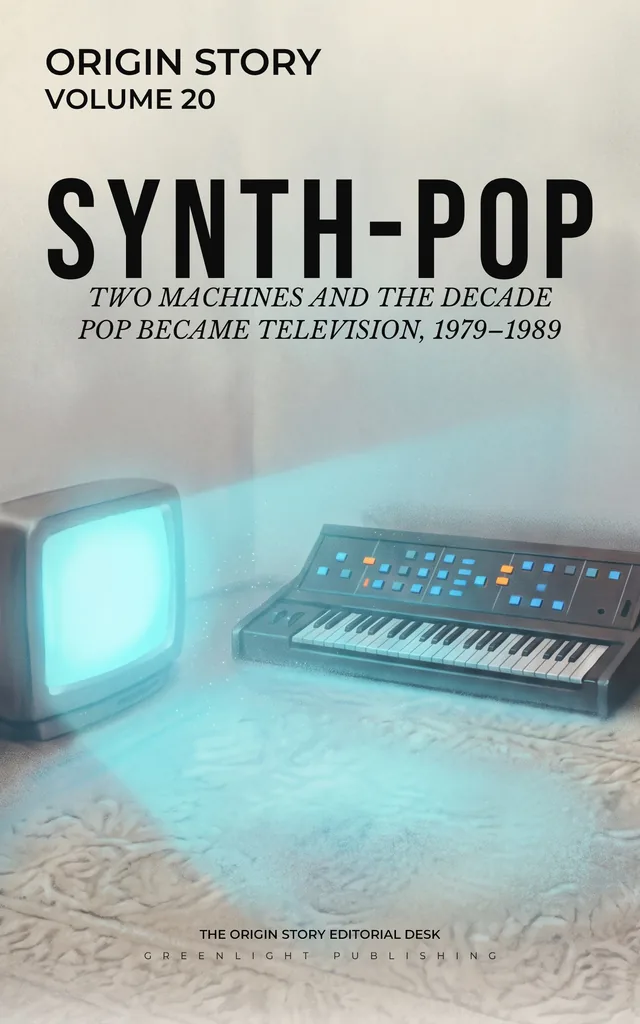
Origin Story · Volume 20 · SYNTH-POPIntroduction
The Minimum Viable Band
In 1979, the smallest unit of pop music got smaller, and almost nobody noticed it happen.
For twenty-five years the minimum viable band had been four people: somebody to sing, somebody on guitar, somebody on bass, somebody on drums. That number was not a convention. It was a technical requirement, fixed by what instruments could do. A guitar plays chords but not basslines and drums. A drummer keeps time but cannot hold a melody. To put a complete piece of pop music in front of an audience you needed four pairs of hands, which meant four people who could tolerate each other, a van to move their equipment, a room loud enough to rehearse in, and (as the previous volume in this series set out at length) a fairly long list of other people’s permissions.
Then the price of a synthesiser fell through the floor, and the arithmetic changed. A synthesiser is an instrument that will be explained properly in this book rather than gestured at, because the explanation is the story, but the short version is this: one affordable machine could produce a bassline, a lead melody, a drone, a texture, or a noise nobody had a name for, one sound at a time, and a second cheap machine could keep the beat all night without complaint, and a third could record the layers one on top of another in a bedroom, quietly, through headphones, without waking anyone. By 1980 the minimum viable band was two people. In several well-documented cases it was one.
At almost exactly the same moment, a second machine changed what a band was for. Since the fifties, the point of a record had been to be heard: on radio, in a shop, at a dance. From August 1981 there existed a television channel in the United States that did nothing, twenty-four hours a day, except play promotional films of pop songs, and it was so short of films to play that it would broadcast almost anything delivered to it in the right format. The countries that had been making those films for years, for their own chart television, suddenly held an advantage nobody had planned. Britain, which had spent the seventies teaching its pop acts to perform to a camera in three minutes, poured through the gap. The result was the largest British landing on the American charts since the Beatles, conducted substantially by acts with synthesisers, eyeliner and no drummer.
The introduction runs on for another 6 paragraphs, and then the book starts. 25 chapters · about 126 pages · $14.99