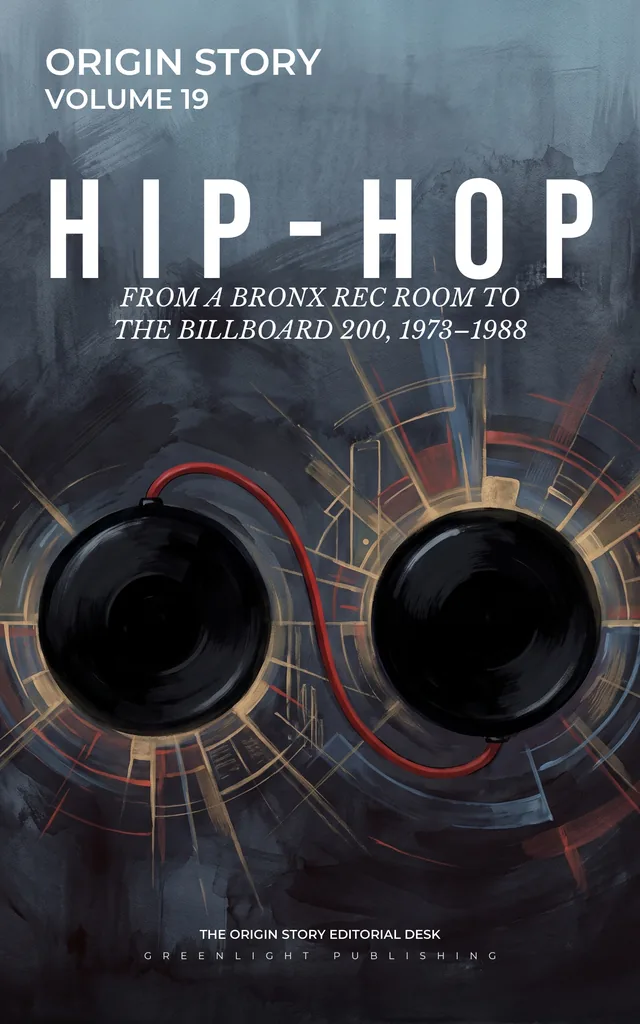
Cover of HIP-HOP, volume 19 of Origin Story

Origin Story  ·  Volume 19  ·  the first written

HIP-HOP

From a Bronx Rec Room to the Billboard 200, 1973–1988

Where it sits on the century

19151973–19882030
$14.99Paperback
about 118 pages

$13.49 each from three copies, $11.49 from sixteen, and $299.00 for all thirty-one with every ebook and audiobook included. Postage is free on every order over $79.

And when it finally reached a record, it was made by none of the people who invented it.

This is the whole story in about three hours. The borough New York had stopped paying for, and the back-to-school party an eighteen-year-old threw to buy school clothes. The problem her brother solved with two copies of the same record — and why that one mechanical trick is the reason every popular song you hear now is built on a loop. The bank clerk, the blackout, the crews whose routines were never recorded. The cheap drum machine that failed commercially because it did not sound like drums, and changed music because it did not sound like drums. The twelve-bit sampler with ten seconds of memory, and why that constraint is the sound of 1988.

It takes the money seriously, because the artists learned to. The flat fee, and what it does to a man whose rhymes are on the biggest-selling rap single ever made and whose name is not on it. Why the publishing was worth three times the record royalty and nobody explained it. What happens when your manager owns the label. The song about a pair of trainers that turned into the first million-dollar endorsement in the genre — and made the record irrelevant.

And it ends where nobody else ends it: in a federal courtroom in 1991, with a judgment that made the previous eighteen years of practice illegal overnight, and changed what these records sound like.

Contains no song lyrics. In a book about an art form made of words, that needs explaining, and the first page explains it. What replaces them is the thing almost nobody writes down: how rapping actually works as rhythm — where the stresses fall, when phrases stop ending where the bar ends, and what changed in 1986.

Format
Paperback
Trim
5.5 × 8.5 in
Pages
about 118
Chapters
31 in five movements
Period
1973–1988
Audiobook
2h 53m

The playlist

ORIGIN STORY: Hip-Hop — public, and sequenced to the order the records appear in Movement Three. The book describes them; the playlist plays them.

Volume 23
GANGSTA RAPwhere this book stops, at the moment the map splits in two
Volume 30
TRAPbuilt on the same Roland drum machine, three decades later and two thousand miles south
Volume 16
DISCOthe music Rapper’s Delight was built out of, and the parent of far more than anybody admitted at the time
Volume 17
PUNKa different city, a different decade, and the same discovery: that the people who own the distribution own the music

Free to read  ·  the opening

How volume 19 starts.

Origin Story · Volume 19 · HIP-HOPIntroduction

Six Years, No Records

Hip-hop was invented in 1973 and did not appear on a record until 1979.

That gap is six years long, and almost nothing in the popular telling of this story prepares you for it. Six years in which a complete art form (with its own technique, vocabulary, star system, competitive structure, audience and economy) existed in the Bronx and then across New York without producing a single commercially released record. No label. No radio. No press coverage worth the name. Not one review.

Sit with the strangeness of that. Every other genre in this series is a story about records, because in every other genre the record is how the music travels. Hip-hop travelled for six years on cassette tapes copied from cassette tapes, sold out of car boots and barber shops and passed hand to hand, and in the memories of people who had been in a park.

And when it finally reached a record, in the autumn of 1979, it was not made by any of the people who invented it.

The introduction runs on for another 12 paragraphs, and then the book starts. 31 chapters · about 118 pages · $14.99

Contents

31 chapters, five movements.

Every volume in the series runs the same five, in this order. What each movement is for.

01The Room6 chapters
  1. 1The Borough They Wrote Off
  2. 211 August 1973
  3. 3Three Kings and a Blackout
  4. 4The MC Was an Afterthought
  5. 5The Crews Who Never Made a Record in Time
  6. 6The Other Three Elements
02The Machine7 chapters
  1. 7Two Copies of the Same Record
  2. 8The Record Collection, the Radio, and the Tape
  3. 9The Machines That Replaced the Turntables
  4. 10The Battle That Kept the Turntables Alive
  5. 11How a Rap Record Was Actually Recorded
  6. 12The Voice as an Instrument
  7. 13How It Left New York
03The Records4 chapters
  1. 141979–1981. Somebody Else Makes the Record
  2. 151982–1984. The Format Fights Back
  3. 161985–1986. The Audience Changes
  4. 171986–1988. The Format Is Taken Over
04The Money8 chapters
  1. 18The Flat Fee
  2. 19Who Owned the Bassline
  3. 20The Dorm Room and the Independents
  4. 21When the Manager Owns the Label
  5. 22The Live Economy, and the Insurance Problem
  6. 23What a Rap Record Actually Earned
  7. 24The Shoe Deal
  8. 25What These Records Earn Now
05The Ending6 chapters
  1. 26Thou Shalt Not Steal
  2. 27What the Story Leaves Out
  3. 28What It Cost
  4. 29What It Became
  5. 30What It Did to Everything Else
  6. 31The Practice Outlived the Format

Free to read  ·  reference

HIP-HOP: the dates.

The book’s own timeline, in full and free to quote. 25 entries, 1973–1988. Where a date is contested the book says so at the point it appears; these are the ones that are not in serious dispute. All thirty-one timelines on one page.

1959–1963
  • the Cross Bronx Expressway opens in sections, having displaced tens of thousands of people.
1968–1975
  • manufacturing leaves the Bronx; landlord arson runs at scale; the city, near bankruptcy in 1975, cuts fire companies in the districts with the most fires.
December 1971
  • a truce meeting after the killing of a Bronx peacemaker; the gang structure begins to shift.
11 August 1973
  • Cindy Campbell’s back-to-school party at 1520 Sedgwick Avenue. Her brother plays the records and extends the break.
1975
  • Grandmaster Flash builds a cue circuit because no mixer has one. Grand Wizzard Theodore, holding a record still, discovers the scratch.
Mid-1970s
  • Afrika Bambaataa founds the Universal Zulu Nation at the Bronx River Houses.
13 July 1977
  • the New York blackout. The number of active crews rises sharply the following year.
1977–79
  • the crews are the draw; the cassette is the distribution; no records exist.
Autumn 1979
  • Rapper’s Delight. A New Jersey label, a house band, three men from outside the scene, and a bassline re-performed from that summer’s biggest disco record. The writers of that record are added to the credits after their side acts.
1980
  • The Breaks becomes the first gold rap single. A Roland drum machine is released, sells badly, and is discontinued.
1981
  • The Adventures of Grandmaster Flash on the Wheels of Steel: seven minutes, one DJ, live.
1982
  • Planet Rock invents electro from a German electronic group’s records and a cheap drum machine; there is a settlement. The Message proves rap can be social description. The New York City Rap Tour reaches Paris and London. Malcolm McLaren releases a record built on New York scratching.
1983
  • Sucker M.C.'s: a drum machine and two voices, and the end of the house-band era. The Bronx drama and the subway documentary appear.
1984
  • the first arena package tour grosses in the millions. A studio film exports the four elements worldwide. A fourteen-year-old answers a Brooklyn group’s single and starts an argument that produces dozens of records.
1985
  • a dorm-room label signs a distribution deal with a major, reported at around six hundred thousand dollars. Radio.
May 1986
  • Raising Hell: several million copies, a scale no rap record had reached. A song about trainers leads to an endorsement deal reported at over a million dollars, the first of its kind in the genre.
November 1986
  • Licensed to Ill becomes the first rap album to top the American chart.
December 1986
  • Salt-N-Pepa’s first album; the first female rap act to go platinum.
March 1987
  • Criminal Minded.
August 1987
  • Scott La Rock is shot and killed, aged twenty-five.
1987
  • a twelve-bit sampler with about ten seconds of memory becomes the defining production tool of the era. Paid in Full changes how rapping is done.
June 1988
  • It Takes a Nation of Millions to Hold Us Back: dozens of uncleared samples per track, which is possible only because nobody has yet established what a sample costs.
August 1988
  • Straight Outta Compton sells in the millions with no radio and no television. The map splits.
1989
  • an assistant director of the FBI writes to the album’s distributor. The letter has no legal force and is the best publicity the group ever gets. New York’s subway runs clean of graffiti for the first time in twenty years.
1991
  • a federal court in Manhattan rules on an uncleared sample, opens the judgment with a commandment about theft, and refers the matter for possible criminal prosecution. Clearance becomes compulsory overnight, and the records audibly change.

Free to read  ·  where it comes from

The sources.

This series is written from published material and its byline claims method rather than credentials, so the sources are listed. They are given as books and categories of material rather than as page citations; where a claim in the text is contested, the text says so at the point of the claim.

The standard histories. Can’t Stop Won’t Stop: A History of the Hip-Hop Generation, Jeff Chang, the fullest single account, and the one that takes the Bronx’s political and economic conditions seriously rather than treating them as scenery; Movement One of this volume is substantially indebted to it. The Big Payback: The History of the Business of Hip-Hop, Dan Charnas, the essential source for Movement Four, and the only book-length treatment of this genre’s business that goes into the contracts. Yes Yes Y’all, Jim Fricke and Charlie Ahearn, an oral history of the pre-record years assembled from interviews with the participants, and the closest thing to a primary source for 1973 to 1979.

On the technique and the technology. Making Beats: The Art of Sample-Based Hip-Hop, Joseph Schloss, the best account of production practice and of the ethics producers actually held. How to Rap: The Art and Science of the Hip-Hop MC, Paul Edwards, an interview-based technical study; this volume’s vocabulary for describing flow is drawn from that tradition of analysis. Bring the Noise and Hip-Hop Family Tree, Ed Piskor, for chronology.

On the Bronx. The Power Broker, Robert Caro, for the Cross Bronx Expressway and the political mechanism behind it. The Bronx Is Burning, Jonathan Mahler, for 1977.

Memoirs and participant accounts, all to be read as interested: Grandmaster Flash, The Adventures of Grandmaster Flash; KRS-One, The Gospel of Hip Hop; Russell Simmons, Life and Def; Rakim, Sweat the Technique; and four decades of interviews with Grandmaster Caz, whose account of Rapper’s Delight is the single most consistently repeated and never seriously contradicted claim in this book.

The films of 1983 and 1984 (the Bronx drama, the subway graffiti documentary, and the studio picture that followed) are primary sources for the practice, not just for its export.

Contemporaneous press. The Village Voice covered this music seriously before anybody else; The Source from 1988. Radio recordings of the New York weekly rap shows survive in substantial quantity and are the best record of what was actually being played.

The party tapes. The primary source for 1975 to 1979, and the most problematic: undated, mislabelled, degraded, of contested provenance, and in some cases not what they claim to be. Movement Two says so at length. Any confident statement about who did what first in those years, in any book including this one, rests on recollection.

On the allegations in Movement One. The accounts made publicly from 2016, the denial, the Universal Zulu Nation’s removal of Bambaataa and its subsequent public apology, and the civil action filed in 2021 are all matters of public record and contemporaneous reporting. This book states those procedural facts and nothing further; readers should go to that reporting rather than to this summary of it.

On the law. The 1991 judgment is a matter of public record and is discussed in every music-business text written since. Creative License, Kembrew McLeod and Peter DiCola, is the fullest treatment of what sample clearance actually costs and does.

Where figures are disputed (the size of the early advances, the attendance and exact character of the first parties, who first did what with a turntable, what any given artist was actually paid) the text says so rather than choosing. Those disagreements are not gaps in the record. In this volume, more than any other in the series, they are the record, because for six years nobody was writing anything down.
What this book does not do

This book quotes no song lyrics. Not one line, not one phrase, not the famous bit.

In a book about hip-hop that requires a longer explanation than it would anywhere else, because you are about to read a history of an art form made of words, written by somebody who will not print the words.

Two reasons, and the second is the interesting one.

The first is legal and it is simple. Lyrics are owned. Licensing them is negotiated song by song, publisher by publisher, territory by territory, and there is no safe quantity, the copyright office says so in as many words, and it names a song as the hard case, because a short work quoted briefly is still a large share of the work. A book that quotes a little is a book making a judgement it cannot check. This one quotes none.

The second is that the constraint makes for a better book about this particular subject, and I want to be honest that this was a discovery rather than a plan.

Hip-hop is the most quoted music in the world. There are a great many books and a great many hours of video that reproduce the famous couplets, and if what you want is the words, they are freely available and you should go and read them, ideally alongside the records. What is much harder to find, and what almost nobody writes, is everything around the words: what a break is and why a DJ needed two copies of the same record; why nobody made a record for six years; what a flat session fee does to a man whose rhymes are on the biggest-selling rap single ever made; how a shoe company changed the economics of a genre; and how the whole thing was reshaped by a judgment handed down in a federal court in 1991.

So this book describes the sound and states the argument. When a record’s words matter (and in this music they almost always matter) you will be told what they are about, in what order, and in what voice. What you will not be told is what they say. That is what the playlist is for.

It also reproduces no album art and no photographs, and it cannot play you a record, which is the real limitation. There is a playlist, sequenced to the order the records appear in these pages. It is called ORIGIN STORY: Hip-Hop. Search for it by name.

Where people in this book have faced serious allegations, it states what is documented (who alleged what, where, the response, and what came of it) and stops there. It does not adjudicate, and it does not leave things out to keep the story tidy.

Where the record is contested, this book says so. Where it does not know, it says that too. Sources are listed at the back.

Shelved under

MUSIC / History & Criticism  ·  MUSIC / Genres & Styles / Rap & Hip Hop  ·  MUSIC / Business Aspects

Identifiers

Ebook ISBN
979-8-90623-809-2
Audiobook ISBN
979-8-90623-810-8
Paperback ISBN
not yet issued

Buy it

Paperback, $14.99, posted direct. Every ebook and audiobook comes free with the complete set.

Questions

About this volume.

What is Origin Story volume 19 about?

From a Bronx Rec Room to the Billboard 200, 1973–1988. Hip-hop was invented in 1973 and did not appear on a record until 1979. Six years — a complete art form with its own technique, star system and economy, existing across New York with no label, no radio, no press and not one review, travelling entirely on cassettes copied from cassettes.

What years does HIP-HOP cover?

1973–1988. The volume is numbered 19 because that is where the genre sits in the chronology of the music, not the order the books were written in — the first three written were volumes 17, 19 and 21.

What made HIP-HOP possible?

Two turntables, then the sampler. Movement Two of every volume is about the technology that made the genre possible and would not have ten years earlier.

Are there song lyrics in it?

None. Not one line, in this volume or in any of the thirty-one. Lyrics are copyrighted expression, licensing is negotiated song by song and publisher by publisher, and there is no safe quantity — so the rule is zero, and a program checks the manuscript, the EPUB and the narration script against it before the volume ships. What replaces them is a description of what the record actually sounds like, what it cost, and who was paid.

How long is it?

About 28,500 words: 31 chapters across five movements, roughly 120 minutes’ reading, 118 pages in the paperback. The audiobook runs 2h 53m.

What is in the back of the book?

A dated timeline of 25 entries, a source list, and a note on what the volume does not do. All three are reproduced free on this page.

Can I buy HIP-HOP in print?

Yes, here. It is a 5.5 × 8.5 in paperback, 60# uncoated cream, black ink, about 118 pages, and it never goes out of print.