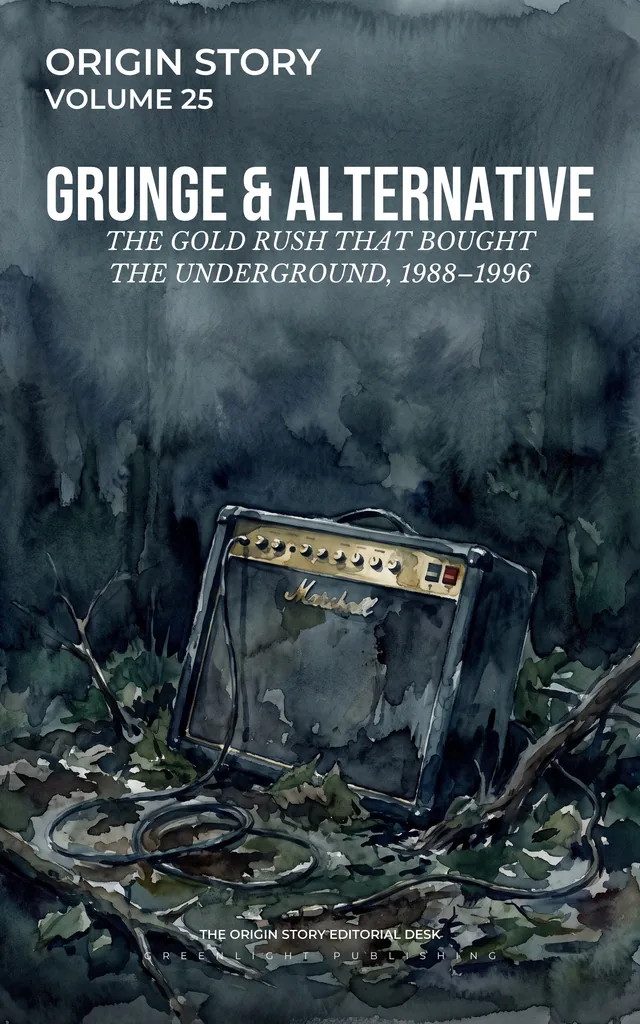
Cover of GRUNGE & ALTERNATIVE, volume 25 of Origin Story

Origin Story  ·  Volume 25

GRUNGE & ALTERNATIVE

The Gold Rush That Bought the Underground, 1988–1996

Where it sits on the century

19151988–19962030
$14.99Paperback
about 122 pages

$13.49 each from three copies, $11.49 from sixteen, and $299.00 for all thirty-one with every ebook and audiobook included. Postage is free on every order over $79.

The machine in this volume is not a device. It is a business process: the major-label A&R gold rush. What an A&R department actually did, and why it had stopped trusting its own ears. What the contract said in the clauses nobody read aloud — the options, the recoupment engine, cross-collateralisation, the controlled composition clause that clipped a songwriter’s one protected income stream. How a bidding war actually formed, and why auction theory guarantees the winner overpaid. And what a regional independent label was actually sold for, from the buyout that saved Sub Pop to the forty-nine per cent stakes the majors took in the culture itself.

The music is taken seriously as music: the dropped tunings that made two guitars sound like weather, the quiet-verse-loud-chorus form built with one pedal, the $606.17 album and the mix that made an underground record detonate on every car stereo in America. The records get their own movement, from Daydream Nation to Vitalogy, including the ones the canon dropped.

And the money is worked in public: the advance arithmetic that left a gold record unrecouped, the merchandising per-heads, the support slot that cost money, the Ticketmaster war that put two musicians in front of Congress, and the three ledgers — the six-hundred-dollar album, the flagship, the casualty — that price the era honestly.

It ends in 1996, when the word alternative was applied to everything and meant nothing, and it says what actually changed instead.

Contains no song lyrics. Not one line. That is a deliberate rule, explained on the first page, and what replaces it is a description of what these records actually sound like.

Format
Paperback
Trim
5.5 × 8.5 in
Pages
about 122
Chapters
25 in five movements
Period
1988–1996
Audiobook
2h 56m

The playlist

ORIGIN STORY: Grunge & Alternative — public, and sequenced to the order the records appear in Movement Three. The book describes them; the playlist plays them.

Volume 17
PUNKthe demonstration, with invoices, that the industry’s doors were never locked
Volume 18
POST-PUNK & NEW WAVEthe independent economy this volume’s underground inherited, and the first time the majors learned to buy it
Volume 23
GANGSTA RAPthe same years, the other gold rush, and the chart machine both of them ran on
Volume 26
BRITPOPthe counter-reaction, assembling in London before this book ends

Free to read  ·  the opening

How volume 25 starts.

Origin Story · Volume 25 · GRUNGE & ALTERNATIVEIntroduction

The Band That Split in Two

In the autumn of 1987 a Seattle band called Green River broke up in the most instructive way any band in this series has ever broken up. They did not fall out over a person, or a sound, or the usual accumulated grievances of a van. They fell out over a question, and the question was: should a band like us sign to a major label?

Two of them said yes. Jeff Ament and Stone Gossard wanted the thing the record industry had always offered, national distribution, tour support, a chance at an audience larger than the few hundred people who came to shows in Seattle. They formed a new band, Mother Love Bone, and within a year they had a major-label deal. Two others said no, or at least not yet, and not like this. Mark Arm and Steve Turner formed Mudhoney, signed to a local independent label that was at that point about a year old and operating out of cheap office space, and became, for the next three years, the most admired band in the American underground.

Hold that split in your mind for the length of this book, because everything in it is a working-out of that argument, at scale, with the entire American record industry as a participant. Within five years both halves of Green River would be proved right, and both would be proved right in ways that cost them. The half that signed produced, through a sequence of events nobody could have planned, one of the biggest rock bands in the world. The half that stayed produced a body of records that defined a sound, watched an industry buy that sound out from under them, and signed to a major themselves in 1992, by which point, as one of them observed in interviews with the dry humour that band never lost, the gesture no longer meant much either way.

This is a book about what happens when capital arrives somewhere it had not been.

The introduction runs on for another 8 paragraphs, and then the book starts. 25 chapters · about 122 pages · $14.99

Contents

25 chapters, five movements.

Every volume in the series runs the same five, in this order. What each movement is for.

01The Room4 chapters
  1. 1A Compilation Called Deep Six
  2. 2A Label That Acted Like a Major
  3. 3The Network the Majors Would Buy
  4. 4Who Was Actually There
02The Machine5 chapters
  1. 5What an A&R Department Actually Did
  2. 6The Contract, Clause by Clause
  3. 7How a Bidding War Formed
  4. 8What an Independent Label Was Actually Sold For
  5. 9Why the Records Sound Like That
03The Records6 chapters
  1. 101988–1990. Before the Rush
  2. 111991. The Year the Chart Stopped Lying
  3. 121992–1994. What the Rush Shipped
  4. 13The Records the Canon Dropped
  5. 14The Ones the Rack Swallowed
  6. 15Three Records That Failed
04The Money6 chapters
  1. 16The Advance Against Yourself
  2. 17The Publishing, Again
  3. 18The T-Shirt and the Ticket
  4. 19What Refusal Paid
  5. 20What a Grunge Record Actually Earned
  6. 21What These Records Earn Now
05The Ending4 chapters
  1. 22What Exhausted It
  2. 23Where It Went
  3. 24What the Story Leaves Out
  4. 25The Label Means Nothing. What Actually Changed

Free to read  ·  reference

GRUNGE & ALTERNATIVE: the dates.

The book’s own timeline, in full and free to quote. 64 entries, 1988–1996. Where a date is contested the book says so at the point it appears; these are the ones that are not in serious dispute. All thirty-one timelines on one page.

1981
  • Mark Arm, in a letter to the Seattle fanzine Desperate Times, mockingly describes his band of the time, Mr. Epp and the Calculations, as pure grunge. The word is a joke for another six years.
1984
  • Black Flag release an album whose second side is deliberately, provocatively slow, and tour the Pacific Northwest. Musicians across the region later cite the shows as permission to stop playing fast.
1985
  • Chris Hanzsek and Tina Casale record six Seattle bands at their own expense.
1986
  • March, the Deep Six compilation is released on C/Z: Green River, Malfunkshun, the Melvins, Skin Yard, Soundgarden, the U-Men.
1987
  • Jonathan Poneman funds Soundgarden’s Screaming Life EP. Green River’s Dry as a Bone appears on Sub Pop with catalogue copy that turns the word grunge into a brand.
  • 31 October. Green River play their last show, opening for Jane’s Addiction, and split over the question this book is about.
1988
  • 1 April. Pavitt and Poneman take Sub Pop full-time.
  • September, Billboard launches its Modern Rock chart.
  • During the year. R.E.M. sign with Warner Bros. for a reported ten million dollars; Mother Love Bone sign with PolyGram.
  • October, Daydream Nation; Mudhoney’s Superfuzz Bigmuff.
  • November, the Sub Pop Singles Club launches with Nirvana’s first single, about a thousand hand-numbered copies.
1989
  • March, Melody Maker publishes the Seattle story its writer was flown in, at the label’s expense, to find.
  • April, Doolittle.
  • June, Bleach, recorded for $606.17. Lamefest at the Moore Theatre.
  • September. Soundgarden’s Louder Than Love on A&M, the first Seattle album of its cohort on a major.
  • December. Lame Fest UK at the London Astoria: Mudhoney, TAD, Nirvana.
1990
  • 19 March. Andrew Wood of Mother Love Bone dies of a heroin overdose, at twenty-four.
  • April. Fugazi’s Repeater.
  • June. Sonic Youth’s first DGC album.
  • July, Apple is released.
  • September. Dave Grohl joins Nirvana.
  • Autumn, a demo tape from Seattle returns from San Diego with Eddie Vedder’s voice on it.
1991
  • Early. TAD’s 8-Way Santa; the cover photograph brings a lawsuit and a recall.
  • March. R.E.M.'s Out of Time goes to number one.
  • April. Nirvana sign with DGC; Sub Pop’s contract is bought out for a reported $70,000 plus a royalty override that will save the label.
  • May, Billboard switches to SoundScan: the chart stops lying. The Smashing Pumpkins’ Gish.
  • August, the International Pop Underground convention in Olympia; Ten.
  • 24 September, Nevermind, initial shipment about 46,000 copies.
  • October, Badmotorfinger. The first Lollapalooza has toured all summer.
1992
  • 11 January, Nevermind reaches number one, displacing Michael Jackson.
  • Spring. Hole sign with DGC on terms reported around a million dollars. The Seattle sweep is general.
  • April. L7’s Bricks Are Heavy.
  • 27 June. Stefanie Sargent of 7 Year Bitch dies, at twenty-four.
  • August, Fontanelle.
  • September, Singles, Core, Sweet Oblivion, Dirt.
  • November, the New York Times prints an invented grunge lexicon; Marc Jacobs shows a grunge collection for Perry Ellis, a show ever since linked in the reporting to his departure from the house the following year.
1993
  • February, In Utero is recorded in two weeks in Minnesota, engineer paid a flat fee, no points.
  • April, the British press turns: a magazine cover tells American rock to go home. Britpop is assembling.
  • Mid-year. Atlantic buys forty-nine per cent of Matador.
  • 7 July. Mia Zapata of the Gits is murdered in Seattle; the scene founds Home Alive. Her killer is convicted a decade later on DNA evidence.
  • September, In Utero enters at number one.
  • October, Vs. sells 950,378 copies in a week, the largest SoundScan total yet measured; Bikini Kill’s Pussy Whipped.
  • The Baffler publishes The Problem with Music.
1994
  • January. Cobain tells Rolling Stone the biggest hit of the era was his attempt to write a Pixies song.
  • March, Superunknown enters at number one.
  • 5 April. Kurt Cobain dies in Seattle of a self-inflicted gunshot wound; his body is found on 8 April; the King County medical examiner rules the death a suicide. He was twenty-seven.
  • 8 April, the Offspring’s Smash is released on Epitaph; it becomes the best-selling independent-label album to date.
  • 12 April, Live Through This.
  • May. Pearl Jam file their memorandum with the Justice Department over ticketing fees.
  • 16 June. Kristen Pfaff of Hole dies, at twenty-seven.
  • 30 June. Gossard and Ament testify before a congressional subcommittee.
  • November, MTV Unplugged in New York; Vitalogy, on vinyl first.
  • December. Bush’s Sixteen Stone: the specification learns to write itself.
1995
  • July, the Foo Fighters’ debut. The Justice Department closes the Ticketmaster inquiry without action; Pearl Jam’s self-ticketed tour buckles.
  • September. Jawbreaker’s Dear You.
  • 21 October. Shannon Hoon of Blind Melon dies, at twenty-eight.
  • Warner Music buys forty-nine per cent of Sub Pop for a price reported around twenty million dollars.
1996
  • January, Hype! premieres.
  • May. Soundgarden’s Down on the Upside.
  • 12 July. Jonathan Melvoin, touring keyboardist for the Smashing Pumpkins, dies of an overdose.
  • Summer. Metallica headline Lollapalooza.
  • August. R.E.M. re-sign with Warner for a reported eighty million dollars, the largest recording contract to date. No Code enters at number one and drops fast. Sloan return on their own label.
1997
  • Spring, the trade press announces the majors’ pivot to electronica. The gold rush moves to the next field.
  • April. Soundgarden dissolve.

Free to read  ·  where it comes from

The sources.

This series is written from published material and its byline claims method rather than credentials, so the sources are listed. They are given as books and categories of material rather than as page citations; where a claim in the text is contested, the text says so at the point of the claim.

Oral histories. Everybody Loves Our Town: An Oral History of Grunge, Mark Yarm, the standard oral account of the Seattle scene, the Sub Pop office, the signings and the aftermath, and the source most often behind this book’s told-by-the-participants anecdotes, including the Green River guest-list story and the A&R-men-in-rental-cars season. Grunge Is Dead: The Oral History of Seattle Rock Music, Greg Prato, covers much of the same ground with a different cast balance. Oral history is read here with the standard caution: recollections, often decades later, by interested parties who disagree with one another, and the text flags the disagreements where they matter.

The scene and the label. Loser: The Real Seattle Music Story, Clark Humphrey, the local history, written from inside the city and published in 1995, before the mythology set. World Domination: The Sub Pop Records Story, Gillian G. Gaar. Bruce Pavitt’s collected Sub Pop USA fanzine columns, for the label’s founding thesis in its own contemporary words. Doug Pray’s documentary Hype! (1996), the scene’s self-audit, filmed while the boom was ending, and the source of several participants’ on-camera accounts used here, including the telling of the New York Times lexicon hoax.

The network. Our Band Could Be Your Life: Scenes from the American Indie Underground 1981–1991, Michael Azerrad, the standard history of the American independent circuit this book’s first movement inherits, and the source for the Black Flag touring economy, the Fugazi economics, and the SST, Dischord and Twin/Tone stories.

Nirvana. Come as You Are: The Story of Nirvana, Michael Azerrad (1993), written with the band’s cooperation and published in Cobain’s lifetime; the source for the reported DGC advance, the Sub Pop buyout terms, the publishing renegotiation, and the quoted remark about the Nevermind mix. Heavier Than Heaven, Charles R. Cross (2001), drawing on estate-provided material, is used sparingly and flagged where its account is the only one. Everett True’s Nirvana: The Biography (2006) is a participant’s account by the journalist Sub Pop flew to Seattle in 1989, and his own published tellings of that flight are the source for the label-funded-press story in Movement One.

Riot grrrl. Girls to the Front: The True Story of the Riot Grrrl Revolution, Sara Marcus, the standard history, written with participants; the Riot Grrrl Collection at NYU’s Fales Library, built from the participants’ own donated zines and papers, is the movement’s primary archive and the reason its record survives the press blackout described in the text.

The business. The Problem with Music, Steve Albini, published in The Baffler no. 5 (1993), the era’s own worked recoupment ledger, summarised with attribution in Movement Four. All You Need to Know About the Music Business, Donald Passman, the clearest general explanation of the contract structures described in Movement Two: option periods, recoupment, cross-collateralisation, controlled composition, merchandising advances; the specific percentages in this book are the standard ranges of the period and are labelled illustrative where they are. The Mansion on the Hill, Fred Goodman (1997), for the corporate history, the label sales, the Geffen-MCA-Matsushita chain, and the money culture the gold rush ran on.

The Ticketmaster war. The June 1994 hearing before a subcommittee of the House Committee on Government Operations, at which Stone Gossard and Jeff Ament testified, is printed in the congressional record; the Justice Department’s 1995 closure of its inquiry, and the collapse of the 1995 self-ticketed tour, were reported extensively in the trade and national press.

The press of the period. Melody Maker's March 1989 Seattle coverage; the New York Times of 15 November 1992, whose invented grunge lexicon is discussed in Movement Five with its inventor’s own later tellings; the January 1994 Rolling Stone interview in which Cobain described the Pixies debt; Billboard and the SoundScan-era charts for every chart position and first-week figure; RIAA certification records for sales milestones; The Rocket, Seattle’s own music paper, for the local record.

Where figures are disputed (the size of advances, the exact points in the Sub Pop buyout, the price of the Warner stake, worldwide sales totals, who first said grunge and meant it) the text hedges at the point of the claim and names the teller where there is only one. Those disagreements are not gaps in the record. They are the record.
What this book does not do

This book quotes nobody and idolises nobody, and both of those are choices worth explaining.

This book quotes no song lyrics. Not one line, not one phrase, not the famous bit. That is a deliberate rule and it is absolute: song lyrics are owned, licensing them is negotiated song by song and publisher by publisher, and there is no safe word count: the copyright office says so in as many words. So this book quotes none, and instead does the harder and more interesting thing, which is to tell you what a record actually sounds like and what its words are about.

It reproduces no album art and no photographs. There is nothing to look at here but words and one flat poster on the cover.

It cannot play you a record, which is the real limitation. What it can do is point. There is a playlist for this book, on the same app you may well be reading or listening on, sequenced to the order the records appear in these pages. It is called ORIGIN STORY: Grunge & Alternative. Search for it by name. Everything described in Movement Three is on it, in order, and the book is substantially better with it running.

One further thing, specific to this volume, and it is important enough to state on the first page. Several of the people in this story died during the years it covers, and one of those deaths has been retold more often, and with more invention, than any other event in the period this series describes. This book states what the public record documents (dates, places, the findings of the medical examiners) and stops. It does not narrate anyone’s last hours, does not speculate about anyone’s state of mind, and does not use a death as the climax of a story about a record business, because it was not one. The people closest to these events are alive. A book written from published sources is entitled to the documented record and to nothing else, and this one takes that limit seriously.

The cost here is real but smaller than it looks: these lyrics have been quoted, misquoted and read as testament for thirty years, and there is nothing left to add by quoting them again. There is a great deal to add about the contracts. The whole story, start to finish, in about three hours. Where it came from, what made it possible, which records mattered and why, who got paid, who did not, and how it ended. Where the record is contested, this book says so. Where it does not know, it says that too. Sources are listed at the back.

Shelved under

MUSIC / History & Criticism  ·  MUSIC / Genres & Styles / Rock  ·  MUSIC / Business Aspects

Identifiers

Ebook ISBN
979-8-90623-917-4
Audiobook ISBN
979-8-90623-918-1
Paperback ISBN
not yet issued

Buy it

Paperback, $14.99, posted direct. Every ebook and audiobook comes free with the complete set.

Questions

About this volume.

What is Origin Story volume 25 about?

The Gold Rush That Bought the Underground, 1988–1996. Punk proved that anybody could make a record — this series showed the invoices. Post-punk built the network that could sell one without the industry’s permission. This book is about what happened when the industry noticed: the five years in which six corporations located the American underground, priced it, and bought it — band by band, label by label, at prices that rose from seventy thousand dollars for a contract to eighty million for a catalogue inside six years.

What years does GRUNGE & ALTERNATIVE cover?

1988–1996. The volume is numbered 25 because that is where the genre sits in the chronology of the music, not the order the books were written in — the first three written were volumes 17, 19 and 21.

What made GRUNGE & ALTERNATIVE possible?

The major-label A&R gold rush. Movement Two of every volume is about the technology that made the genre possible and would not have ten years earlier.

Are there song lyrics in it?

None. Not one line, in this volume or in any of the thirty-one. Lyrics are copyrighted expression, licensing is negotiated song by song and publisher by publisher, and there is no safe quantity — so the rule is zero, and a program checks the manuscript, the EPUB and the narration script against it before the volume ships. What replaces them is a description of what the record actually sounds like, what it cost, and who was paid.

How long is it?

About 29,000 words: 25 chapters across five movements, roughly 120 minutes’ reading, 122 pages in the paperback. The audiobook runs 2h 56m.

What is in the back of the book?

A dated timeline of 64 entries, a source list, and a note on what the volume does not do. All three are reproduced free on this page.

Can I buy GRUNGE & ALTERNATIVE in print?

Yes, here. It is a 5.5 × 8.5 in paperback, 60# uncoated cream, black ink, about 122 pages, and it never goes out of print.