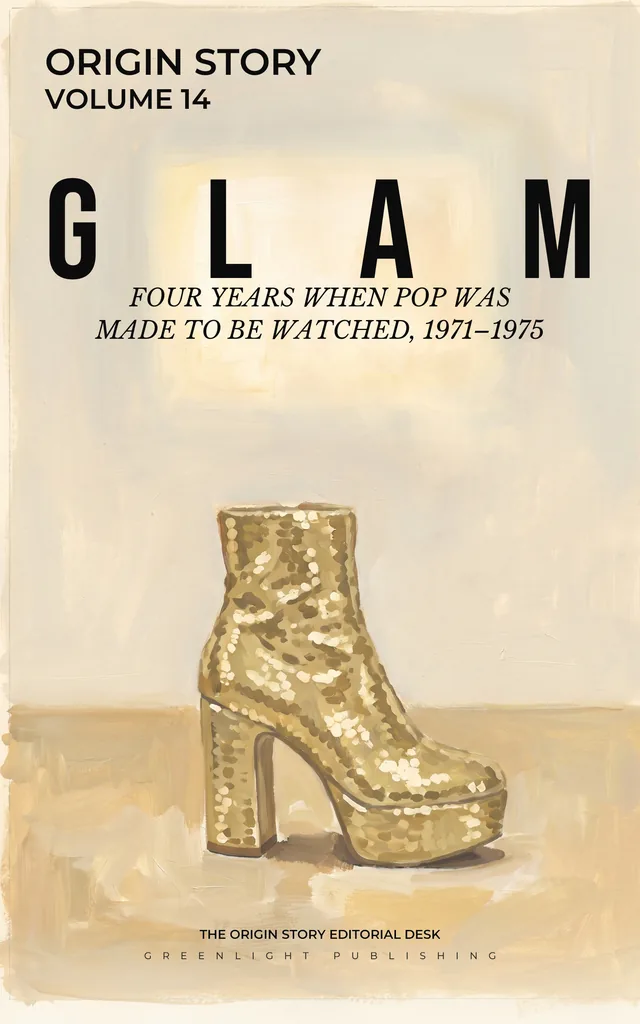
Cover of GLAM, volume 14 of Origin Story

Origin Story  ·  Volume 14

GLAM

Four Years When Pop Was Made to Be Watched, 1971–1975

Where it sits on the century

19151971–19752030
$14.99Paperback
about 122 pages

$13.49 each from three copies, $11.49 from sixteen, and $299.00 for all thirty-one with every ebook and audiobook included. Postage is free on every order over $79.

This is the complete story of glam in about three hours: the failed mod who became T. Rex and lit the fuse; the one-hit wonder from Beckenham who built a character called Ziggy Stardust, launched him like a product, and retired him the same way; the art students who arrived with the theory and the ballroom bands who arrived with the craft; and the factory upstream — the songwriter-producer teams and producer-owned companies who owned the copyrights, owned the masters, and hired the faces.

It takes the money seriously, because the era’s ledgers are the story. Why a band with three number ones stayed on thirty pounds a week while its producers built empires. What a Christmas single is worth, every December, forever, to the two men who wrote it. How the biggest star in the book discovered he was effectively an employee of his own management company, and what it cost him to get out. And why an act built on a look had roughly three years of chart life, to the month.

It states the era’s criminal record plainly — the convictions, and the posthumous inquiries into the man who presented the machine itself — without sensationalising and without looking away.

And it answers the question the nostalgia industry skips: how it ended. Not with a death — with a decision on a Hammersmith stage, and an absorption into the arenas, the dancefloors and every pop career since that has managed itself in eras.

Contains no song lyrics. Not one line. That is a deliberate rule, explained on the first page, and what replaces it is a description of what these records actually sound like — the siren that opens the Sweet’s biggest hit, the two-chord riff that held number one and number two in the same week under different names, the stillness you can somehow hear in the Sparks record.

Format
Paperback
Trim
5.5 × 8.5 in
Pages
about 122
Chapters
24 in five movements
Period
1971–1975
Audiobook
2h 58m

The playlist

ORIGIN STORY: Glam — public, and sequenced to the order the records appear in Movement Three. The book describes them; the playlist plays them.

Volume 16
DISCOthe audience’s half of the dressing-up licence, relocated to the dancefloor
Volume 17
PUNKthe Dolls’ wardrobe and the contract lesson, inherited by a generation that made the invoice part of the art
Volume 20
SYNTH-POPthe children of the July 1972 broadcast, and the machine itself set free of the studio

Free to read  ·  the opening

How volume 14 starts.

Origin Story · Volume 14 · GLAMIntroduction

Seen Before Heard

Every genre in this series has a machine in it, the technology that made the music possible and would not have ten years earlier. Usually the machine changed what a record cost, or who was allowed to make one. This is the first volume in the series where the machine changed something else: what a record was for.

Here is the mechanism, stated at the start because the whole book hangs on it.

In Britain in 1971 there were three television channels. One of them, on Thursday evenings, broadcast a programme built directly on the singles chart: acts mimed their current records, the running order followed the chart, and the rules of the format meant that, with rare exceptions, you appeared only while your record was climbing. The audience was routinely counted in excess of ten million people (in the peak weeks the figures cited at the time ran to fifteen) in a country of fifty-six million. There was no way to record the programme at home and no repeat. If you were watching, you were watching with everyone else, at the same moment, usually in the same room as your family.

Now follow the loop. An appearance on Thursday sold records on Friday and Saturday. The shops’ sales fed the next chart. The next chart earned the next appearance. Three minutes of national broadcast, converted directly into next-week sales, converted back into more broadcast, a feedback loop with a seven-day period, running through a single studio in London. Nothing like it existed in America, which is most of the reason the music in this book barely existed in America. The genre grew where the machine was.

The introduction runs on for another 8 paragraphs, and then the book starts. 24 chapters · about 122 pages · $14.99

Contents

24 chapters, five movements.

Every volume in the series runs the same five, in this order. What each movement is for.

01The Room4 chapters
  1. 1The Boy Who Had Tried Everything
  2. 2The Actor
  3. 3Art School and the Palais
  4. 4New York Had the Look and No Channel
02The Machine5 chapters
  1. 5Thursday Evening, Fifteen Million People
  2. 6Miming, and What It Did to a Record
  3. 7Colour Comes to the Living Room
  4. 8What the Chart Actually Was
  5. 9The Factory Upstream
03The Records5 chapters
  1. 101971–1972. The Door Opens
  2. 111973. The Machine at Full Speed
  3. 12December 1973. The Loudest Month
  4. 131974–1975. The Formula Runs Down
  5. 14Three Records That Failed
04The Money6 chapters
  1. 15The Fastest Money in the Business
  2. 16The Production Company Owns the Master
  3. 17Who Wrote It Kept It
  4. 18MainMan, or the Star as Subsidiary
  5. 19Touring Against a Hit Single
  6. 20The Half-Life of a Face
05The Ending4 chapters
  1. 21The Man Who Fired Himself
  2. 22Where the Look Went
  3. 23The Reckoning
  4. 24What Actually Changed

Free to read  ·  reference

GLAM: the dates.

The book’s own timeline, in full and free to quote. 38 entries, 1971–1975. Where a date is contested the book says so at the point it appears; these are the ones that are not in serious dispute. All thirty-one timelines on one page.

1964
  • 1 January, the first edition of Top of the Pops, from a converted church in Manchester. Jimmy Savile presents.
1969
  • February, the BMRB begins compiling the official singles chart from a sample of shops’ sales diaries.
  • July, Space Oddity, released into the fortnight of the moon landing, becomes Bowie’s first hit.
  • November. BBC1 and ITV begin colour broadcasts.
1970
  • October, Ride a White Swan. Tyrannosaurus Rex has become T. Rex, and the acoustic duo has become an electric band.
1971
  • February–March, Hot Love begins six weeks at number one. On a Top of the Pops appearance that spring, Bolan performs with glitter under his eyes.
  • June. Slade’s revival of a fifties shouter reaches the chart; television does the rest.
  • September, Electric Warrior.
  • Autumn. Bowie signs to RCA. Tony Defries incorporates MainMan the following year.
1972
  • January. Bowie tells Melody Maker he is gay; the interview is part of the Ziggy launch. March, as Gary Glitter, the former Paul Raven releases the two-part stomp built with Mike Leander.
  • June, The Rise and Fall of Ziggy Stardust and the Spiders from Mars.
  • 6 July, Starman on Top of the Pops: the arm around Ronson, the finger down the lens.
  • August, School’s Out is number one; Virginia Plain and All the Young Dudes arrive in the same weeks.
  • November, the New York Dolls’ first British visit ends with the death of their drummer Billy Murcia.
1973
  • January, Blockbuster at number one with The Jean Genie beneath it: the same borrowed riff, twice.
  • March, Cum On Feel the Noize enters at number one, the first record to do so since the Beatles. 20th Century Boy.
  • April, Aladdin Sane enters at number one on six-figure advance orders.
  • June, Can the Can: Suzi Quatro, the genre’s one full female franchise, at number one.
  • 3 July. Hammersmith Odeon. Bowie retires Ziggy Stardust from the stage.
  • July, the New York Dolls’ debut album is released and fails commercially.
  • September, Ballroom Blitz. Wizzard’s second number one of the year.
  • October, the oil embargo begins; Jobriath’s hyped debut is released into American indifference.
  • December, Merry Xmas Everybody against I Wish It Could Be Christmas Everyday; a million-selling Christmas pressed against a vinyl shortage, with television under a crisis curfew and the three-day week announced.
1974
  • January, Tiger Feet, the year’s biggest British single.
  • February, Rebel Rebel, Bowie’s farewell single to the genre.
  • May, This Town Ain’t Big Enough for Both of Us: Sparks conquer the machine by standing still.
  • July, The Six Teens, the factory’s last Sweet top-tenner; the partnership dissolves within months.
  • Autumn. Bell Records is folded into Arista. Bowie tours America; the soul pivot follows in the spring.
1975
  • March, Fox on the Run, self-written, out-charts the factory’s work for the Sweet at home and in America.
  • Spring–summer. Rollermania: the machine runs at full power on an act with no glam in it. Gary Glitter’s run of top-tens ends.
  • September. Bowie’s first American number one: a funk record about fame, co-written with John Lennon.
  • October, Love Is the Drug: Roxy Music arrive at the dancefloor.
  • November–January, Bohemian Rhapsody holds number one for nine weeks behind a promotional film made because the band could not attend; the machine learns the performer is optional.
1977
  • Summer. Bolan’s afternoon television series books the new punk bands; its final edition ends with Bolan and Bowie performing together.
  • 16 September. Marc Bolan dies in a car crash in south-west London, aged twenty-nine.
1997
  • Bowie securitises his catalogue (fifty-five million dollars of bonds against his own royalties) having spent two decades buying back what the seventies had taken.
1999–2024
  • The Gadd convictions: Bristol Crown Court, 1999; Vietnam, 2006; Southwark Crown Court, 2015, for offences committed 1975–1980; recall to prison, 2023; civil damages, 2024.
2011–2016
  • Savile dies celebrated; the documentary, the joint police–NSPCC report and the Dame Janet Smith Review then document the abuse, including on the programme’s premises. Repeat runs of the programme now skip the editions he presented.

Free to read  ·  where it comes from

The sources.

This series is written from published material and its byline claims method rather than credentials, so the sources are listed. They are given as books and categories of material rather than as page citations; where a claim in the text is contested, the text says so at the point of the claim.

The genre entire. Shock and Awe: Glam Rock and Its Legacy, Simon Reynolds, the fullest modern history of the genre, and the account that takes its ideas most seriously; this book’s sense of glam as a theory of the self owes it a general debt. Glam Rock: Dandies in the Underworld, Alwyn W. Turner, for the British social texture; Barney Hoskyns’s Glam! for the earlier standard telling.

Bowie. Strange Fascination, David Buckley, and Starman, Paul Trynka, the standard biographies, and the principal published accounts of the MainMan structure and settlement, alongside Alias David Bowie by Peter and Leni Gillman, whose financial reporting the money movement draws on with the hedges stated there. Spider from Mars, Woody Woodmansey’s memoir, for the Hammersmith night from inside the band. Michael Watts’s January 1972 Melody Maker interview is quoted from its own text; Bowie’s 1983 walk-back is in his Rolling Stone interview of that year.

Bolan. Mark Paytress’s biography Bolan: The Rise and Fall of a 20th Century Superstar, and Tony Visconti’s autobiography for the studio years. The glitter-under-the-eyes story is told, with the variations the text notes, across these and the period press.

The factory wing. The Chinn–Chapman method is documented in the long interviews both men have given across five decades, including the BBC’s The Record Producers strand; Mickie Most’s stated philosophy is from his own interviews. The Sweet’s account of their session-players era is in Steve Priest’s memoir Are You Ready, Steve? and decades of consistent band interviews; Mud’s wage years and Rob Davis’s second career are from the members’ own tellings. The Alvin Stardust substitution is told in both Peter Shelley’s and Bernard Jewry’s published accounts. Suzi Quatro’s Unzipped covers the RAK years from the artist’s side.

Mott, Roxy, and the art wing. Ian Hunter’s Diary of a Rock’n’Roll Star (the best contemporary document of what touring at this level actually paid and cost) and his accounts of the Bowie song’s arrival; Michael Bracewell’s Re-make/Re-model for Roxy Music’s art-school formation; Brian Eno’s and Bryan Ferry’s period interviews.

Television. The BBC’s own published histories of Top of the Pops and the surviving editions themselves; the Musicians’ Union miming arrangements as described in participants’ accounts, with the enforcement caveats the text carries. For the chart: the Official Charts Company’s published history of the BMRB era, and the trade and investigative press coverage of chart hyping the text characterises.

The reckoning. Giving Victims a Voice, the joint Metropolitan Police and NSPCC report, January 2013; The Dame Janet Smith Review Report, BBC, February 2016, the findings cited are those documents’ own. The Gadd convictions are reported from the contemporaneous court reporting of 1999, 2006, 2015, 2023 and 2024 (BBC News, the Guardian, the national press); the King conviction from the 2001 court reporting, with the 2018 collapse reported as the text states it. Press investigations of continuing songwriter royalties are cited in the text as press reporting, which is what they are.

Charts, sales and certifications are from the Official Charts Company and BPI (Britain) and Billboard and the RIAA (America). Colour-television licence figures are from the BBC’s annual handbooks and licensing statistics; the 1973–74 energy crisis measures, including the broadcasting curfew and the three-day week, are from the contemporaneous official record and press.

Where figures are disputed (the size of advances, the terms of the MainMan settlement, the annual earnings of a Christmas copyright, the exact night the glitter first appeared) the text says so at the point of the claim rather than choosing. Those disagreements are not gaps in the record. They are the record.
What this book does not do

This is a book about a music that was largely looked at, and it contains no pictures. That needs explaining.

This book quotes no song lyrics. Not one line, not one phrase, not the famous bit. That is a deliberate rule and it is absolute, and song lyrics are owned, licensing them is negotiated song by song and publisher by publisher, and there is no safe word count: the copyright office says so in as many words. A book that quotes a little is a book making a legal judgement it cannot check. So this one quotes none, and instead does the harder and more interesting thing, which is to tell you what a record actually sounds like and what its words are about. For this particular genre the rule costs less than you might think, because glam’s records were built so that the words were the least important part.

It reproduces no album art, no photographs and no television footage. There is nothing to look at here but words and one flat poster on the cover, which, for a book whose whole argument is about looking, is an irony the writing has to earn its way past.

And it cannot play you a record. What it can do is point. There is a playlist for this book, on the same app you may well be reading or listening on, sequenced to the order the records appear in these pages. It is called ORIGIN STORY: Glam. Search for it by name. Nearly everything described in Movement Three is on it, in order; one record described in these pages has been left off it deliberately, and the chapter called The Reckoning explains why.

One more thing, and it belongs here rather than buried at the back. Some of the people in this book were later convicted of serious crimes, and the presenter most identified with its central television programme was the subject, after his death, of official inquiries that documented abuse on a very large scale. This book states those records plainly, at the point in the story where they belong, with dates and outcomes. It does not sensationalise them, it does not speculate beyond what courts and inquiries found, and it does not leave them out to keep the story comfortable. A history that omits them is not tidier. It is false.

Where the record is contested, this book says so. Where it does not know, it says that too. Sources are listed at the back.

Shelved under

MUSIC / History & Criticism  ·  MUSIC / Genres & Styles / Rock  ·  MUSIC / Business Aspects

Identifiers

Ebook ISBN
979-8-90623-901-3
Audiobook ISBN
979-8-90623-902-0
Paperback ISBN
not yet issued

Buy it

Paperback, $14.99, posted direct. Every ebook and audiobook comes free with the complete set.

Questions

About this volume.

What is Origin Story volume 14 about?

Four Years When Pop Was Made to Be Watched, 1971–1975. In 1971 Britain had three television channels, no home recording, and one programme about pop at family hour, built directly on the singles chart. Its audience was counted in excess of ten million. An appearance on Thursday sold records on Friday; the sales fed the next chart; the chart earned the next appearance. Into that loop stepped a small man with glitter under his eyes, and popular music acquired its first genre designed to be seen before it was heard.

What years does GLAM cover?

1971–1975. The volume is numbered 14 because that is where the genre sits in the chronology of the music, not the order the books were written in — the first three written were volumes 17, 19 and 21.

What made GLAM possible?

Television. Movement Two of every volume is about the technology that made the genre possible and would not have ten years earlier.

Are there song lyrics in it?

None. Not one line, in this volume or in any of the thirty-one. Lyrics are copyrighted expression, licensing is negotiated song by song and publisher by publisher, and there is no safe quantity — so the rule is zero, and a program checks the manuscript, the EPUB and the narration script against it before the volume ships. What replaces them is a description of what the record actually sounds like, what it cost, and who was paid.

How long is it?

About 29,500 words: 24 chapters across five movements, roughly 125 minutes’ reading, 122 pages in the paperback. The audiobook runs 2h 58m.

What is in the back of the book?

A dated timeline of 38 entries, a source list, and a note on what the volume does not do. All three are reproduced free on this page.

Can I buy GLAM in print?

Yes, here. It is a 5.5 × 8.5 in paperback, 60# uncoated cream, black ink, about 122 pages, and it never goes out of print.