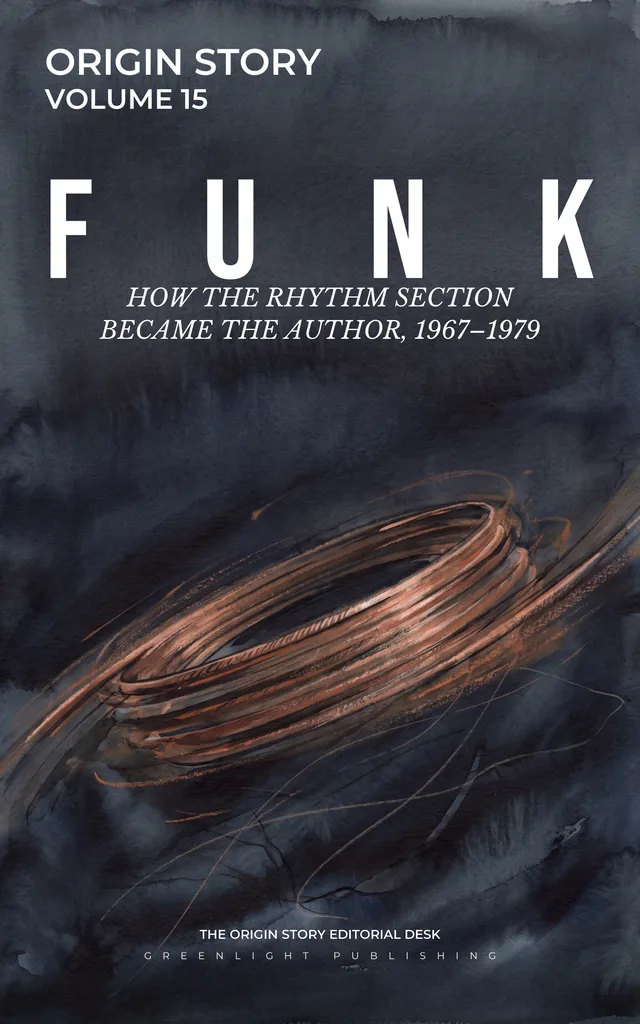
Cover of FUNK, volume 15 of Origin Story

Origin Story  ·  Volume 15

FUNK

How the Rhythm Section Became the Author, 1967–1979

Where it sits on the century

19151967–19792030
$14.99Paperback
about 128 pages

$13.49 each from three copies, $11.49 from sixteen, and $299.00 for all thirty-one with every ebook and audiobook included. Postage is free on every order over $79.

This is the complete story of funk in about three hours: the touring revue where the language was drilled, with fines for a wrong note or a scuffed shoe; the San Francisco disc jockey who designed an integrated, mixed-gender family band; the New Orleans corner studio where four names went on every credit; and the mid-sized Ohio city that exported funk bands like a crop.

It explains the machine in plain language, for readers who cannot read music and do not need to: what actually changes when the emphasis moves, how a guitar becomes a drum, what a bass line does when it stops following the chord and starts stating the form, and why an arrangement built from interlocking one-bar parts is a different kind of composition from anything a chord chart can hold.

And it takes the money as seriously as the music, because the genre’s central question is a money question and it is still in the courts: who owns a groove a room full of people assembled? What a sideman was actually paid, and fined. Why the writing credit on collectively built music recorded power rather than authorship. The touring revue’s ledger, where a thirteen-piece payroll ate the margin a four-piece rock band kept. And the strangest afterlife in this series: records that paid their players a flat session fee becoming the most sampled body of music on earth, generating five decades of income for whoever held the paper — while the drummer who played the most reproduced eight bars in history worked club dates in Wisconsin.

The ending is not a death. It is an absorption and a displacement — into disco, into the machines, and into a Bronx afterlife that turned these grooves into the raw material of the next genre.

Contains no song lyrics. Not one line. That is a deliberate rule, explained on the first page, and this volume is where it costs least: funk’s words were rarely the point, and a beat can be described down to the sixteenth-note without asking anybody’s permission.

Format
Paperback
Trim
5.5 × 8.5 in
Pages
about 128
Chapters
26 in five movements
Period
1967–1979
Audiobook
3h 07m

The playlist

ORIGIN STORY: Funk — public, and sequenced to the order the records appear in Movement Three. The book describes them; the playlist plays them.

Volume 7
SOULthe two great machines this book’s musicians stood just outside, and the rhythm sections it kept at their edges
Volume 16
DISCOthe grid regularised for the club, and what its economy then survived
Volume 19
HIP-HOPthese records, eight bars at a time, becoming the next music entirely
Volume 21
HOUSE & TECHNOthe grid with no band left at all, alive in a Chicago warehouse

Free to read  ·  the opening

How volume 15 starts.

Origin Story · Volume 15 · FUNKIntroduction

Where the Weight Falls

Here is the smallest description of what this book is about. In American popular music before 1967, the weight of the beat fell in one place. After 1967, it fell somewhere else. That is the whole revolution. Everything in this volume (the bands, the records, the fortunes made and not made, the court cases still running half a century later) follows from a decision about where, in a bar of four beats, the emphasis lands.

It sounds too small to matter. It is roughly the size of deciding which syllable of a word to stress, and a change that size in speech would give you an accent. In music it gave you a genre, and the genre turned out to be the most durable raw material popular music has ever produced.

The previous volume of this series ended in 1972 with two great machines breaking, a Detroit company that ran its rhythm section like an assembly line, salaried, anonymous and superb, and a Memphis company that let its rhythm section build the records in the room and put the players’ names on the writing credits. That book kept one man deliberately at its edges, because he was not a company and did not behave like one. He was a machine unto himself: bandleader, employer, quality-control department and product in a single person, drilling one of the great ensembles of the century on gymnasium stages and cutting records between shows. This book starts with him, because the thing he and his musicians assembled in the middle 1960s (on the road, mostly, in soundchecks and dressing rooms rather than in any famous studio) is the thing every other band in this book picked up and ran with.

What they assembled needs stating carefully, because it is genuinely technical and the technical part is the story. Between roughly 1965 and 1967, in James Brown’s band and then very quickly beyond it, the interest of a record moved out of the tune and into the rhythm. Not "the rhythm got better", the rhythm became the content. Songs stopped changing chords, because harmony was no longer where the information was. Melodies shrank to fragments, because the voice was becoming another drum. And the emphasis of the whole ensemble was gathered up and placed, hard, on the first beat of the bar (on the one, in the phrase Brown’s musicians made a doctrine) so that everything a band played became a cycle: one bar long, repeated, every instrument locking a small pattern against every other, all of it leaning towards the next downbeat like a wheel coming round. Played properly, it does something to a room that four centuries of European harmony never managed. This book will spend a whole movement explaining how it works, in plain language, on the assumption that you cannot read music and do not need to.

The introduction runs on for another 8 paragraphs, and then the book starts. 26 chapters · about 128 pages · $14.99

Contents

26 chapters, five movements.

Every volume in the series runs the same five, in this order. What each movement is for.

01The Room4 chapters
  1. 1The Hardest-Working Room in Show Business
  2. 2A Disc Jockey in San Francisco
  3. 3A Corner Bar, a Barbershop, and the City of Funk
  4. 4Who Was Actually There
02The Machine5 chapters
  1. 5The One
  2. 6The Guitar Becomes a Drum
  3. 7The Bass Stops Following the Chord
  4. 8Interlock
  5. 9Getting It on Tape
03The Records6 chapters
  1. 101965–1967. The New Bag
  2. 111968–1970. Say It Loud
  3. 121971–1972. Two Answers to a Darkening Room
  4. 131973–1975. The Groove Goes Industrial
  5. 141976–1979. The Mothership, and the Border
  6. 15The Records the Standard Telling Drops
04The Money6 chapters
  1. 16The Bandleader as Employer
  2. 17The Credit in the Room
  3. 18Who Owned the Songs
  4. 19The Revue’s Ledger
  5. 20What a Funk Record Actually Earned
  6. 21The Afterlife. A Flat Fee, Compounding for Somebody Else
05The Ending5 chapters
  1. 22What Absorbed It
  2. 23What Replaced the Band
  3. 24Where the Players Went
  4. 25What the Story Leaves Out
  5. 26The Rhythm Section Was the Author

Free to read  ·  reference

FUNK: the dates.

The book’s own timeline, in full and free to quote. 47 entries, 1967–1979. Where a date is contested the book says so at the point it appears; these are the ones that are not in serious dispute. All thirty-one timelines on one page.

1956
  • Please Please Please, on Federal: James Brown’s first hit, and the beginning of the revue economy.
1962
  • 24 October. Brown records the Apollo show at his own expense, against his label’s judgement.
1963
  • Live at the Apollo released; it reaches number two on the album chart and stays on the chart over a year.
1964–65
  • (Brown’s contract war: a release through a rival label, an injunction, and the 1965 settlement that gives him a production company and unprecedented terms. February 1965) Papa’s Got a Brand New Bag cut in Charlotte.
1967
  • May, Cold Sweat cut at King, Cincinnati: one chord, the break, the credit shared with the arranger.
  • Summer, Funky Broadway puts the word on the charts. The Parliaments finally hit; the label collapses; the name is lost.
  • Sly and the Family Stone, formed the previous year, sign to Epic.
1968
  • 5 April, the televised Boston Garden show, the night after Dr King’s murder.
  • Spring, Dance to the Music top ten.
  • August. Say It Loud (I’m Black and I’m Proud) recorded; number one rhythm and blues for six weeks.
  • Brown buys his first radio station.
1969
  • Spring (Cissy Strut; Stand!; It’s Your Thing, on the Isleys’ relaunched T-Neck) Motown’s suit over it eventually fails.
  • August. Woodstock, half past three in the morning.
  • November, the Funky Drummer session at King.
1970
  • March, the band’s ultimatum and the overnight replacement: Bootsy Collins’s Pacemakers become the J.B.'s.
  • July, Sex Machine. Funky Drummer released.
  • December. Brown’s band and Fela Kuti’s watch each other in Lagos.
1971
  • March. Arlester "Dyke" Christian shot dead in Phoenix.
  • July, Maggot Brain.
  • November, There’s a Riot Goin’ On; Family Affair number one, a rhythm box keeping time.
1972
  • 15 February, federal copyright extended to sound recordings, prospectively only: the masters of nearly everything above remain outside it.
  • Summer, Think (About It), on People.
  • October, Superstition.
1973
  • October, Head Hunters. Wild and Peaceful. Funky Worm has topped the rhythm-and-blues chart; The Payback is cut and rejected by the film it was made for.
1974
  • September. Robbie McIntosh dies at twenty-four.
  • The Meters play the New Orleans sessions for the following spring’s number one. The Payback is reported as Brown’s first gold album.
1975
  • February–May, Fire, Pick Up the Pieces and Shining Star all reach number one within four months: the boom’s peak.
  • Wesley and Parker leave Brown for Clinton. Chocolate City; Mothership Connection in December. The tax demand reported at around four and a half million dollars arrives.
1976
  • Give Up the Funk goes gold; the Mothership flies nightly; Bootsy’s Rubber Band tours as a second P-Funk franchise.
1977
  • Brick House: six names on the groove, one on the ballads. Flash Light cut: the bass line is three stacked Minimoogs.
1978
  • 1 January, the statutory mechanical rate rises for the first time since 1909: two cents becomes two and three-quarters.
  • Flash Light number one rhythm and blues; One Nation Under a Groove number one for six weeks; a Minneapolis teenager’s debut carries four jobs and one name.
1979
  • June, Good Times number one.
  • 12 July, the Comiskey Park demolition; the format purge follows.
  • August, a funk band’s B-side carries the first commercially released rap; the purpose-built hit overtakes it within weeks.
  • Autumn, Ladies’ Night: the conversion executed. The span closes with the language everywhere and the format finished.
  • After the span, compressed because endings have paperwork.
1980
  • Zapp’s talk-box debut; the one-man era opens in earnest.
1986
  • A film-soundtrack single returns Brown to the top five.
1991
  • The Manhattan sampling ruling: the market for this book’s grooves becomes compulsory.
2001
  • The Bridgeport campaign: hundreds of actions on the P-Funk copyrights.
2005
  • The appeals court’s licence-or-do-not ruling over a two-second Funkadelic chord.
2006
  • 25 December, James Brown dies, aged seventy-three.
2015
  • A jury awards Sly Stone five million dollars over diverted royalties; another prices a 1977 groove’s feel.
2016
  • A different circuit rejects the 2005 rule; Bernie Worrell dies.
2017
  • Clyde Stubblefield dies at seventy-three, the most-heard drummer in the world.
2018
  • federal law finally reaches the pre-1972 masters.

Free to read  ·  where it comes from

The sources.

This series is written from published material and its byline claims method rather than credentials, so the sources are listed. They are given as books and categories of material rather than as page citations; where a claim in the text is contested, the text says so at the point of the claim.

The James Brown organisation. RJ Smith, The One: The Life and Music of James Brown, the fullest documentary biography, and the principal cross-check for dates and business events. Fred Wesley, Hit Me, Fred: Recollections of a Sideman, the single most valuable inside account this genre has of pay, fines, credits and working method, and the source this book flags wherever a wage figure or a credit story is one participant’s telling. James Brown’s own memoirs, with Bruce Tucker and others, read as the interested accounts they are. The 2014 documentary Mr. Dynamite and four decades of interviews with the band’s alumni (Maceo Parker, Pee Wee Ellis, Clyde Stubblefield, John "Jabo" Starks, Bootsy Collins) for the fine system, the 1970 walkout and the making of the founding records.

The other organisations. George Clinton’s memoir and the assembled oral histories of Parliament-Funkadelic, for the two-band strategy, the Mothership economics and the publishing disputes, all interested testimony, flagged as such. Maurice White’s memoir for Earth, Wind & Fire. Jeff Kaliss and subsequent interviewers for Sly and the Family Stone; Sly Stone’s own late memoir; contemporary Rolling Stone reporting for the missed-shows era. Band-member interviews across decades for the Meters, Kool & the Gang, the Ohio Players, War, Tower of Power and the Average White Band.

The scholarship. Rickey Vincent, Funk: The Music, the People, and the Rhythm of The One, the standard survey and the book that named the field. Anne Danielsen, Presence and Pleasure: The Funk Grooves of James Brown and Parliament, the rigorous musicological account behind this book’s machine movement, though every simplification here is this book’s own. Robert Farris Thompson, Flash of the Spirit, for the contested etymology reported in the final movement.

On the business. The mechanics in Movement Four (royalty structures, packaging and free-goods deductions, recoupment, the writer-publisher split, mechanical and performance royalties) are standard industry practice of the period, set out most clearly in Donald Passman, All You Need to Know About the Music Business; the specific percentages in the worked example are identified in the text as illustrative. The statutory mechanical rate and the 1972 and 1978 changes are matters of federal statute. The American Federation of Musicians’ published scale sheets of the period for session rates.

The court record. The sampling and publishing litigation is documented in the published opinions: the 1991 Manhattan sampling ruling; Bridgeport Music v. Dimension Films (2005) and the Bridgeport litigation campaign of 2001, reported extensively in the trade press; the 2016 appellate decision that split the circuits; the 2015 verdicts in Sly Stone’s royalty action and the estate case over a 1977 groove’s feel. George Clinton’s claims regarding the assignment documents, and Bridgeport’s denials, are drawn from the parties’ filings and public statements and are presented in the text as claims, with the courts’ outcomes stated.

For chart positions, certifications and dates, the Billboard archives and the Recording Industry Association of America’s certification database.

Where figures are disputed (the Apollo recording’s financing, the wages in Brown’s band, the city of the 1970 walkout, the cost of the Mothership, the reported grosses of the late sixties, the ownership history of more than one catalogue) the text names the teller or gives the range rather than choosing. Those disagreements are not gaps in the record. In this genre above all, they are the record.

What this book does not do

Three things this book will not give you, and what it does instead.

This book quotes no song lyrics. Not one line, not one phrase, not the famous bit. That is a deliberate rule and it is absolute, and song lyrics are owned, licensing them is negotiated song by song and publisher by publisher, and there is no safe word count: the copyright office says so in as many words. A book that quotes a little is a book making a legal judgement it cannot check. So this one quotes none, and instead does the harder and more interesting thing, which is to tell you what a record actually sounds like and what its words are about. For this particular volume the rule costs less than it costs any other book in the series, because funk’s words were rarely the point. The point was the beat, and a beat can be described down to the sixteenth-note without asking anybody’s permission.

It reproduces no album art and no photographs. There is nothing to look at here but words and one flat poster on the cover.

And it cannot play you a record, which is the real limitation, and there is no point pretending otherwise. What it can do is point. There is a playlist for this book, on the same app you may well be reading or listening on, sequenced to the order the records appear in these pages. It is called ORIGIN STORY: Funk. Search for it by name. Everything described in Movement Three is on it, in order, and the book is substantially better with it running.

This volume pays almost nothing for the rule, because the music is a rhythmic argument and its words are frequently one repeated phrase. What it buys is space for the two things the subject actually turns on: how the parts interlock, and who was credited for them. The whole story, start to finish, in about three hours. Where it came from, what made it possible, which records mattered and why, who got paid, who did not, and how it ended. On this subject the money question is not a sideline. It is the most contested question in the genre, it is still in the courts, and this book takes it as seriously as the music.

Where the record is contested, this book says so. Where it does not know, it says that too. Sources are listed at the back.

Shelved under

MUSIC / History & Criticism  ·  MUSIC / Genres & Styles / Soul & R 'n B  ·  MUSIC / Business Aspects

Identifiers

Ebook ISBN
979-8-90623-903-7
Audiobook ISBN
979-8-90623-904-4
Paperback ISBN
not yet issued

Buy it

Paperback, $14.99, posted direct. Every ebook and audiobook comes free with the complete set.

Questions

About this volume.

What is Origin Story volume 15 about?

How the Rhythm Section Became the Author, 1967–1979. Around 1967, the weight of American popular music moved. The emphasis gathered onto the first beat of the bar — on the one, in the phrase James Brown’s musicians made a doctrine — and the interest of a record moved out of the tune and into the rhythm. Songs stopped changing chords. The band stopped being furniture behind a song and became its author.

What years does FUNK cover?

1967–1979. The volume is numbered 15 because that is where the genre sits in the chronology of the music, not the order the books were written in — the first three written were volumes 17, 19 and 21.

What made FUNK possible?

The one, and the rhythm section as author. Movement Two of every volume is about the technology that made the genre possible and would not have ten years earlier.

Are there song lyrics in it?

None. Not one line, in this volume or in any of the thirty-one. Lyrics are copyrighted expression, licensing is negotiated song by song and publisher by publisher, and there is no safe quantity — so the rule is zero, and a program checks the manuscript, the EPUB and the narration script against it before the volume ships. What replaces them is a description of what the record actually sounds like, what it cost, and who was paid.

How long is it?

About 31,000 words: 26 chapters across five movements, roughly 130 minutes’ reading, 128 pages in the paperback. The audiobook runs 3h 07m.

What is in the back of the book?

A dated timeline of 47 entries, a source list, and a note on what the volume does not do. All three are reproduced free on this page.

Can I buy FUNK in print?

Yes, here. It is a 5.5 × 8.5 in paperback, 60# uncoated cream, black ink, about 128 pages, and it never goes out of print.